Washington
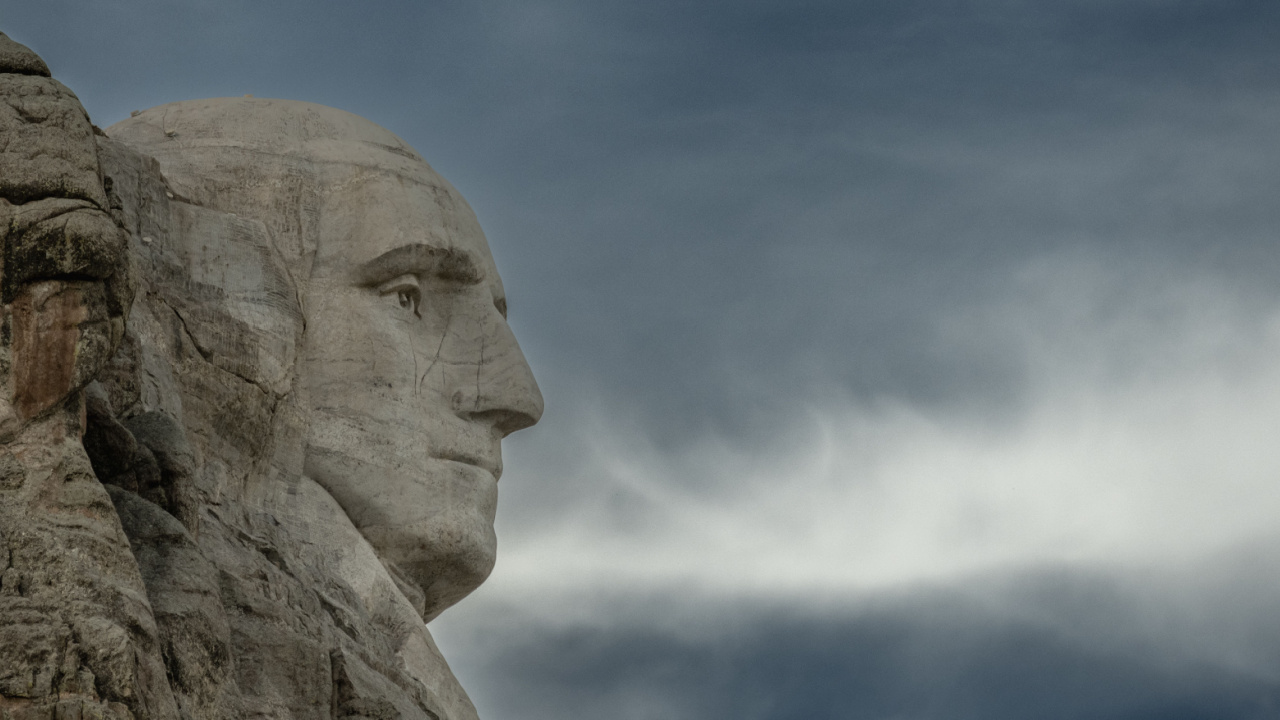
Editor's Note
This story appears annually at tomklingenstein.com on February 22, in commemoration of 250 years — and counting — of American independence.
Great men are the ambassadors of Providence sent to reveal to their fellow men their unknown selves.
Today is George Washington’s birthday. We honor him every year on this day because he deserves all the honor we can give him and more, and because it is good for us. To honor his greatness, we must contemplate it. To contemplate it, we must rise to it.
George Washington lived 67 years, from 1732 to 1799. During his last 24 years—more than a third of his life—he was the foremost man in America, the man on whom the fate of his country depended more than on any other man. And these were fateful years.
From 1775 to 1783—the years of the American War of Independence—Washington was Commander-in-Chief of the Continental Army upon whose victory the thirteen colonies depended to secure their separate and equal station among the powers of the earth. In the summer of 1787, he presided over America’s Constitutional Convention.
His presence lent decisive significance to the document drafted there, which, so long as it continues in force, will remain the oldest written constitution in the world. From 1789-1796, he held the highest office in the land as the first president of the United States of America under this constitution. The office of president had been designed with his virtues in mind.
In each of these capacities, and as a private citizen between and after his several public offices, Washington, more than any American contemporary, was the necessary condition, the sine qua non, of the independence and enduring union of the American states.
It was in mere honest recognition of this that time bestowed upon him the epithet, Father of our Country. In the course of his life, Washington’s fate became inseparable from the fate of his country. By the time of his death, he was identified in the eyes of the world with America and the cause of liberty for which America stood. His greatness was a testament to America’s promise. The significance of that testament has not diminished with time. It is still true, all these years after it was first said, that “Our history is but a transcript of his claims on our gratitude.”
The pre-eminent positions he held, the unrivalled honors he received, can only hint at the greatness of Washington. They are rays cast by the light of his greatness itself, the qualities of mind and character that shone brilliantly in all these positions and fully deserved all these honors—and more. To the extent that the country of which he was the father was, in principle, the best possible country, the measure of his greatness knows no parochial bounds.
Countless witnesses attest that, however astonishing Washington’s many particular excellences might be, the sum was even greater than the parts: the whole man somehow magnified the individual virtues of which he was composed. His courage, energy, high principles, and steadfastness; his impartial justice and utter trustworthiness; that he was calm in the face of danger and dauntless in adversity; that he would sacrifice repose for fame and fame to duty; his thoroughness in deliberation and mastery over his strong passions—these and his other distinguishing characteristics, laudable in themselves, are elevated still further as they are harmonized in the great soul of Washington. In this way, he was a living example of Aristotle’s great souled man, in whom all the virtues are active in their highest perfection and take on a radiance even beyond their perfection.
When Washington was a mere 22 years old, he had already been appointed commander of the armies of Virginia (such as they were). His actions in the field had already won him notoriety in Europe and fame in Virginia. By the time he retired from military service at the age of 26 and returned to private life, his commanding presence, courage, resolution, incorruptible justice, and firm sense of duty were widely known throughout Virginia. Already, his destiny seemed to fellow citizens to be tied to the destiny of his “country” (that is, Virginia).
Twenty-seven of the officers who served under the young Washington presented an Address to him (December 31, 1758) upon his retirement, expressing their gratitude for his leadership and imploring him not to resign. Their youthful tribute to the youthful Washington anticipates the man whose destiny would become inseparable from the destiny of a greater country, when it called him from his private station some seventeen years later.
In our earliest infancy, you took us under your tuition, trained us up in the practice of that discipline which alone can constitute good troops . . . . Your steady adherence to impartial justice, your quick discernment and invariable regard to merit, wisely intended to inculcate those genuine sentiments of true honor and passion for glory, . . . first heightened our natural emulation and our desire to excel. How much we improved by those regulations and your own example, with what cheerfulness we have encountered the several toils, especially while under your particular direction, we submit to yourself . . . . Judge then how sensibly we must be affected with the loss of such an excellent commander, . . . How great the loss of such a man? . . . It gives us additional sorrow, when we reflect, to find our unhappy country will receive a loss no less irreparable than ourselves. Where will it meet a man . . . so able to support the military character of Virginia? . . . In you we place the most implicit confidence. Your presence only will cause a steady firmness and vigor to actuate in every breast, despising the greatest dangers and thinking light of toils and hardships, while led on by the man we know and love.
Such were the impressions and the sentiments of men who knew and served under Washington in his early twenties.
When George Washington died, on December 14, 1799, there was throughout America a profound outpouring of grief at the country’s loss, gratitude for his life, and deep reverence for his memory.
For two months after Washington’s burial at Mount Vernon, his countrymen continuously expressed their bereavement in private correspondence, in resolutions of Congress and of State legislatures, in town meetings, in the pages of newspapers and, most singularly, in hundreds of funeral processions and solemn eulogies in every corner of the nation.
America’s greatest orators vied with one another to do justice to the greatness of this great man. From the Senate of the United States:
With patriotic pride, we review the life of our Washington, and compare him with those of other countries who have been pre-eminent in fame. Ancient and modern names are diminished before him. Greatness and guilt have too often been allied, but his fame is whiter than it is brilliant. . . . Let his countrymen consecrate the memory of the heroic General Washington, the patriotic statesman and the virtuous sage. Let them teach their children never to forget that the fruit of his labors and his example are their inheritance.
Congressman Henry Lee, on behalf of the House of Representatives:
First in war—first in peace—and first in the hearts of his countrymen, he was second to none in the humble and endearing scenes of private life; pious, just, humane, temperate and sincere; uniform, dignified and commanding; his example was as edifying to all around him as were the effects of that example lasting. . . . [C]orrect throughout, vice shuddered in his presence and virtue always felt his fostering hand; the purity of his private character gave effulgence to his [public] virtues. . . . Such was the man for whom our nation mourns.”
Nor were the memorials confined within American shores. “The whole range of history,” wrote the editor of the Morning Chronicle in London, “does not present to our view a character upon which we can dwell with such entire and unmixed admiration. The long life of General Washington is not stained by a single blot. . . . His fame, bounded by no country, will be confined to no age.” Even Napoleon delivered a eulogy at the Temple of Mars. That Washington would walk away from all the military and political powers conferred upon him and return to private life inspired King George III to consider him “the greatest character of the age.”
Abigail Adams was right in saying: “Simple truth is his best, his greatest eulogy. She alone can render his fame immortal.” The trouble is that, where Washington’s greatness is concerned, the simple truth almost surpasses belief. But a vast variety of people at widely different times and in greatly different circumstances testified to his greatness with remarkably consistent detail. A decent respect to the opinions of mankind, recommended both by Aristotle and the American revolutionaries, requires that we take these opinions seriously enough to seek the reasons for them.
Greatness is by definition extraordinary, and what is extraordinary is by definition rare. It takes nothing away from parents or friends to say that most of us do not know personally someone with truly extraordinary gifts or capacities. And yet, it is extraordinary qualities that most clearly reveal what is good—what is the standard of excellence in any field—by revealing more clearly the limits of what is possible. We see more clearly what baseball is, so to speak, when we see Babe Ruth swing the bat. After seeing him play—after studying him—those of us who play the game know better what to aspire to and the rest of us understand more fully the highest standards by which the game should be judged.
Like Babe Ruth, a Shakespeare or a Mozart displays qualities or capacities that would have been difficult or impossible to imagine without his example. In this way, those with the greatest gifts reveal to the rest of us—they make visible—human potential that we might otherwise never have realized on our own. They are ambassadors of Providence, as Calvin Coolidge said, revealing to us our unknown selves. They do this by helping reveal to us human nature itself, since we cannot understand human nature until we have some idea what human beings are capable of, and we can’t take a proper measure of ourselves until we understand that.
What Shakespeare is to poetry, Mozart to music, or Babe Ruth to baseball, George Washington is to manhood itself. He possessed and displayed in his life courage, self-control, justice, judgment and an array of other virtues in such full harmony and to such a degree, and he surmounted such great challenges in so many circumstances of war and peace, that to see how he lived his life is to see much more vividly what it means to be a man. This is by no means to say that he was flawless any more than Babe Ruth was a perfect baseball player. It is merely to say that, if he had not lived, such greatness could hardly have been imagined.
In the order of nature, with no material impediments, a virtuous soul would manifest itself, according to Aristotle, in a beautiful body. Recorded impressions of Washington’s contemporaries make very clear that his physical appearance—his stature, bearing, and countenance—reflected to a remarkable degree the distinctive qualities of his soul. As the Marquis de Chastellux records in his notes,
[T]he strongest characteristic of this respectable man is the perfect harmony which reigns between the physical and moral qualities which compose his personality. . . . It is not my intention to exaggerate. I wish only to express the impression General Washington has left on my mind, the idea of a perfect whole.
The physical manifestation of the soul’s virtues can enhance their effect. Washington’s sheer personal presence was a significant and characteristic part of his greatness and of his influence on the world. In battle and in counsel, he often exerted a powerful impact on those around him just by being there and being the man he was. As Lafayette observed at the Battle of Monmouth, where Washington’s appearance on the scene stopped a confused and panicked retreat, “General Washington seemed to arrest fortune with one glance.”
The mere image of Washington was a source of strength and encouragement to the Revolutionary and Founding generation of Americans, but time has removed him from the active imaginations of most Americans or left at best a faded distortion of the original. This is our loss. We can benefit ourselves by rekindling in our mind’s eye those features of Washington that so eloquently reflected his virtues and inspired his compatriots to noble deeds.
Here is how a fellow officer described him when he was just 26.
[S]traight as an Indian, measuring six feet two inches in his stockings, and weighing 175 pounds. . . . His frame is padded with well-developed muscles, indicating great strength. His bones and joints are large, as are his hands and feet. He is wide shouldered but has not a deep or round chest; is neat waisted, but is broad across the hips and has rather long legs and arms. His head is well-shaped, though not large, but is gracefully poised on a superb neck. A large and straight rather than a prominent nose; blue gray penetrating eyes which are widely separated and overhung by a heavy brow. His face is long rather than broad, with high round cheek bones, and terminates in a good firm chin. He has a clear though rather a colorless pale skin which burns with the sun. A pleasing and benevolent though a commanding countenance, dark brown hair which he wears in a cue.
His mouth is large and generally firmly closed, but which from time to time discloses some defective teeth. His features are regular and placid with all the muscles of his face under perfect control, though flexible and expressive of deep feeling when moved by emotions. In conversation, he looks you full in the face, is deliberate, deferential, and engaging. His voice is agreeable rather than strong. His demeanor at all times composed and dignified. His movements and gestures are graceful, his walk majestic, and he is a splendid horseman.
When he was selected Commander-in-Chief of the Continental Army, Washington’s appearance began to become familiar to his countrymen and to the world. The Morning Post and Daily Advertiser in London reported that “Not a king in Europe but would look like a valet de chambre by his side.”
The painter Gilbert Stuart was to find
features in his face totally different from what I had observed in any other human being. The sockets of the eyes, for instance, were larger than what I had ever met before, and the upper part of the nose broader. . . . All his features were indicative of the strongest passions, yet, like Socrates, his judgment and self-command made him appear of a different cast in the eyes of the world. . . . Had he been born in the forests . . . he would have been the fiercest man among the savage tribes.
In 1789, Jedidiah Morse described Washington as
tall, upright, and well made; in his manner easy and unaffected. His eyes were of a bluish cast, not prominent, indicative of deep thoughtfulness, and when in action, on great occasions remarkably lively. His features strong, manly, and commanding; his temper reserved and serious; his countenance grave, composed, sensible. There was in his whole appearance an unusual dignity and gracefulness which at once secured him profound respect, and cordial esteem. He seemed born to command his fellow men.
What common soldiers repeatedly confirmed in more homely style, Gouverneur Morris, in his eulogy of Washington in 1799, said in lofty phrases:
Born to high destinies, he was fashioned for them by the hand of nature. His form was noble—his port majestic. On his front were enthroned the virtues which exalt, and those which adorn the human character. So dignified his deportment, no man could approach him but with respect—none was great in his presence. You have all seen him, and you all have felt the reverence he inspired. . . .
Such, then, was the outward manifestation of Washington’s great soul. A multitude of witnesses, of many nationalities, friends and enemies, different political parties, young and old, military and civilian, men and women of high and low station confirm what Dr. James Thacher recorded in 1778:
The serenity of his countenance, and majestic gracefulness of his deportment, impart a strong impression of that dignity and grandeur, which are his peculiar characteristics, and no one can stand in his presence without feeling the ascendancy of his mind, and associating with his countenance the idea of wisdom, philanthropy, magnanimity, and patriotism.
To know this Washington is to understand why a patriotic soldier in desperate times might beg him to be king of America; to understand Washington is to know why this could not be.