The Reader Forum: “The System Keeping Affirmative Action Alive”

Editor's Note
Each week, we share observations on X about the issues shaping our nation and society. These exchanges have become an ongoing civic dialogue, shaped by readers willing to wrestle openly with difficult questions. Follow Tom’s account to take part in the discussion as it unfolds.
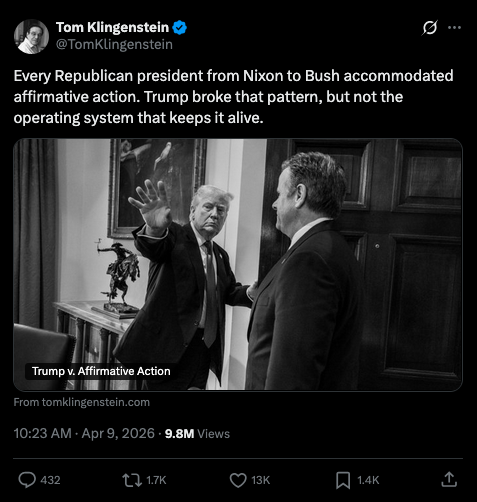
On X we wrote: “Every Republican president from Nixon to Bush accommodated affirmative action. Trump broke that pattern—but not the operating system that keeps it alive. Jesse Merriam explains…” Our readers didn’t hold back.
The big picture:
Jesse Merriam’s essay struck a chord with readers who see affirmative action not as a policy debate, but as a regime — a machinery of racial preferences that has outlived every court ruling meant to kill it, survived every Republican president who promised to rein it in, and mutated into new forms whenever one door closed. The consensus was stark: Trump has done more than any of his predecessors to confront this system, but the deeper architecture remains intact.
The dominant sentiment:
Readers returned again and again to one principle: the only legitimate standard is merit, and any deviation from it is a betrayal of the very justice affirmative action claimed to advance.
@JamesCBispo: “Affirming racism is not a positive action. Merit only, justice is blind fir a reason!”
MuzzleNews: “‘Affirmative action’ just means lowering standards for perceived racial radical egalitarianism.”
Understanding the enemy:
Several readers zeroed in on precisely what Merriam called the “operating system” — the administrative, institutional, and ideological scaffolding that keeps affirmative action alive despite legal defeats and political reversals.
TimothyBair: “Despite SCOTUS declaring it unconstitutional and illegal…deep state keeps violating the law”
aalex2: “And we’ve come the the end of it’s usefulness. Unless, of course, you want to include illegals which seems to be the new push.”
aalex2’s warning points toward the mutation Merriam anticipates: the regime does not die, it migrates, with illegal immigration now emerging as the next preferred category.
From the Hill:
Two Republican elected officials joined the conversation directly, and their responses echoed Merriam’s central concern — that this is not a discrete policy fight but a theater in a larger civilizational struggle.
Rep. Chip Roy: “The battle against woke and weaponized government is a part of the larger battle in defense of Western Civilization. The Trump administration is courageously fighting that war on multiple fronts.”
Rep. Josh Williams: “Trump exposed it, but DEI proves the system never went away. If we want real fairness and a country where people are judged on merit, we have to dismantle it completely.”
Rep. Roy situates the fight as civilizational; Rep. Williams names the specific mechanism — DEI — by which the system evades its legal defeats. Together, their responses reinforce Merriam’s thesis: the fight is not over; the apparatus persists, and the work of dismantling it is both legislative and cultural.
Yes, but:
One reader pushed back on the diagnosis itself, redirecting the blame from accommodationist Republicans to the party that built and defended the regime in the first place.
JudDeSilvaLK: “Every Democratic President from Kennedy to Biden”
The rejoinder is pointed: it is Democrats who authored and defended the operating system, even if Republicans failed to dismantle it. For this reader, the focus belongs on the architects, not only the accommodators.
The other side:
Another strand of replies resisted the sharpest condemnation, acknowledging that affirmative action had a plausible beginning even as they agreed it has long since outlived any legitimate purpose.
67lld: “It was needed back during Nixon and Ford. But after that starting the 1980s, it wasn’t necessary any longer and still continued. Since the 1960s, this has been huge reparations.”
RelaxedPop: “Affirmative action was being abused. It was necessary in the 60’s and 70’s, but its usefulness was diminished each passing year. It started to be used as a weapon and created ridiculous scenarios such as raising Kamala Harris to the position of Vice President.”
These readers split the difference: an original purpose, however well-intentioned, has long since curdled into its opposite.
The bottom line:
Tom’s readers and Jesse Merriam’s essay converge on the same uncomfortable truth: The courts have ruled, the presidents have rotated, and the affirmative action regime has adapted to every one of them. For this audience, Trump’s willingness to break the decades-long pattern of Republican accommodation is a real and rare victory — but a victory over the symptom, not the system. Until the moral architecture of the civil rights regime is confronted directly, each apparent defeat of affirmative action will prove temporary, and each victory provisional.