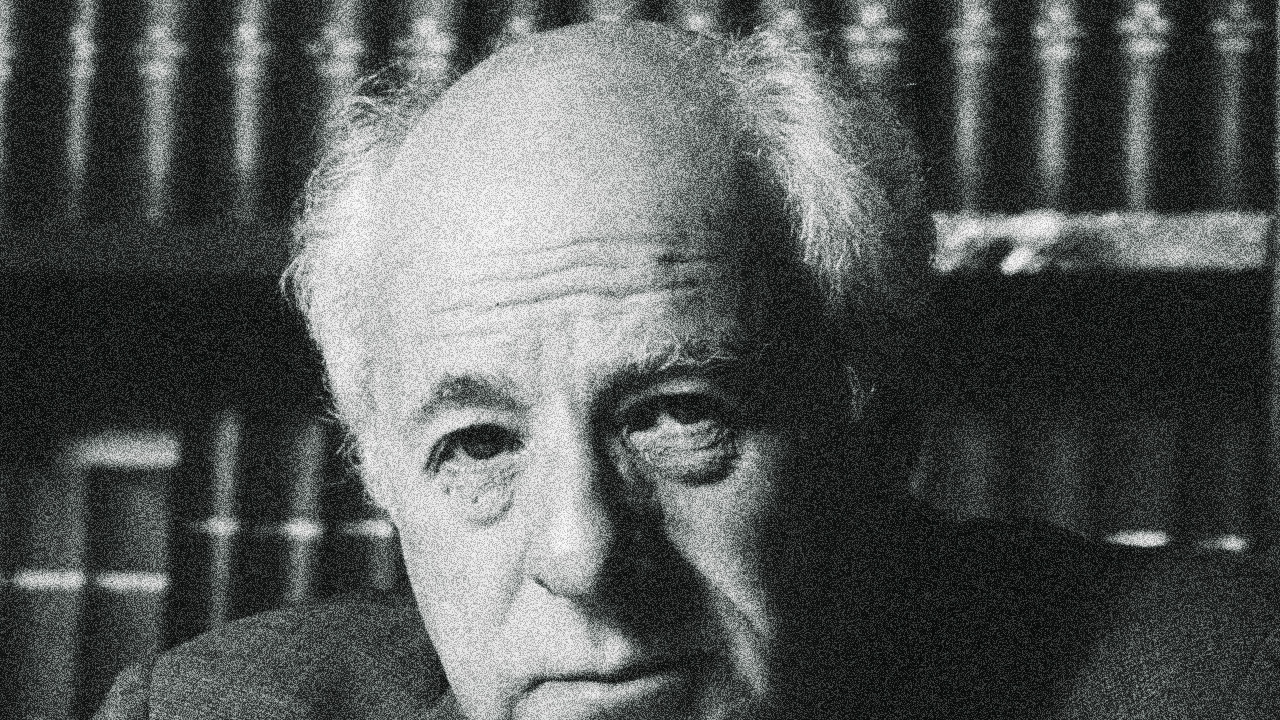
Norman Podhoretz (1930–2025)
Editor's Note
This essay from Tom Klingenstein appeared originally in the Claremont Review of Books, in celebration of Norman Podhoretz, who passed away in 2025.
Despite initial doubts, Norman Podhoretz became passionately attached to President Donald Trump, going so far as to suggest that the appearance of Trump was “providential.” How else could one explain the coming of this most unpresidential man, who, although manifestly unfit to be president at any other time, was just the man for this (perilous) time? If I tell you something about my experience with Norman, Trump’s appeal might become clearer.
In 1995 I made what I then thought was a generous contribution to Commentary magazine. It was unsolicited, even indirectly, and I rarely, if ever, made unsolicited contributions, certainly not “generous” ones. What prompted this unusual behavior was the announcement that Norman Podhoretz was, after 35 years, retiring as editor of Commentary. I had not at that point even laid eyes on Norman, but I felt close to him because he had been faithfully looking out for me for the 20 years I had been reading Commentary.
Norman assumed his readers were intelligent but that we had little specialized knowledge, and so whenever there was even a chance of confusion, he would explain. He avoided jargon, arcane references, and unfamiliar words. In an essay he edited, or in one of his own, he pulled you along at a fast trot. Norman would tell you where he was going, and remind you along the way. He was always at your side to make sure you didn’t get lost. His style was almost conversational. And he had the touch and sensibilities of a novelist.
As John Podhoretz wrote shortly after his father’s death on December 16 last year, at age 95, “What you really need to know is that what mattered most to him was writing.” Clear, forceful, and honest writing. Norman often said to me, and I suspect said even more often to John, that he was a “sucker for a good sentence.” He had to be careful that he was not beguiled by a false idea hiding in an artful sentence.
He thought ideas drove politics, and so writing was a serious business—indeed, he wrote as though the fate of America and of Israel depended on the quality of his writing and the writing of those he edited. Ideas, and talking about them, mattered so much that he could not quite fathom how I could marry a woman who was as liberal as I am conservative.
Norman’s appreciation for great writing may have helped patch up his relationship with Henry Kissinger, as unlikely as this may sound. They clashed at first, mostly over the wisdom of détente, but eventually became close friends. Norman talked about Kissinger often. More than once he told me that upon reading the first volume of his memoirs he realized, much to his astonishment, that Kissinger was a great writer. Norman must have thought that a man who could write so well had a soul and so might be worthy of friendship.
In the last three years of his life, I saw Norman often—weekly if I could. But at the beginning of our relationship, which I think was shortly after my initial contribution to Commentary, I saw him for lunch only a few times a year, though the frequency of these lunches increased over time. The purpose of one of these lunches was to ask me for money for Commentary. I always preempted this ask by handing Norman a check shortly after sitting down. I did this because I assumed he was uncomfortable asking for money. But apparently not. According to him, he was actually a very good fundraiser, much to his surprise.
Norman went to two plays of mine. At the first one, in 2018, he turned to his best friend, his wife Midge Decter, before it began and told her he regretted coming. “I am not going to like it,” he told Midge, “and then I shall have to tell Tom.” Those who knew Midge can predict her response: “If you don’t like it, why don’t you just shut up?” But as she knew better than anyone, Norman was incapable of shutting up, particularly when it came to his opinions on the arts. He had to tell you what he thought, and without pulling punches, sugarcoating, or apologies. Anything less, he thought, was cowardice.
Perhaps this rather exalted sense of courage came from the rough and tumble Brooklyn neighborhood of his youth. As Norman described it, as a young boy he would find himself standing toe to toe with a much bigger boy, black as often as not, who was threatening to thrash Norman for the sin of being white or Jewish or both. For most of us, standing our ground would be all that courage demanded. But not for Norman. He needed to push the much bigger boy, ensuring the thrashing he desperately wanted to avoid but knew he must endure. Had Norman not pushed he would have judged himself a “sissy,” and in his young moral world there could not have been a more serious sin than that. As in this case, Norman’s instinct was to confront rather than appease, whether the adversary was the Soviet Union, a radical Arab state, or an intellectual combatant.
The subject of sissies brings me to Jews, most of whom vote for Democrats even though, Norman thought, their interests are better served by Republicans. But as Norman pointed out, Jews often take pride in treating self-interest as though it were selfishness. To Norman this was perverse, and violated his first commandment: stand up for yourself and your own.
And there was something else about the Jews’ preference for the Democratic Party that rankled Norman: Democrats are inclined to focus on America’s deficiencies, whereas Norman hardly ever did. Nor did he apologize for America’s sins. After all, it was only in America that a first-generation, poor Jewish boy from Brooklyn could make it—roots he never forgot, nor let his readers forget. He considered this unqualified acceptance a minor miracle and he could not for the life of him understand why most Jews didn’t appreciate this.
(By the way, Norman liked my play very much. According to Midge, he whispered to her a few times, noting something in the play that he thought referred to political philosopher Harry V. Jaffa. That Jaffa was anywhere in my play was a surprise to me—the play had absolutely nothing to do with politics—but I am certain Norman was right. A good critic often sees deeper than the artist himself, much as a good editor, like Norman, often sees deeper into an essay than the writer himself.)
At first, I had wanted to see Norman to express my gratitude and rub shoulders with an important conservative intellectual. But I wanted to keep seeing him, to be his friend, because of his inner warmth. On the outside he was often gruff and crusty, but, as he once told me, this was an act—intended, I assume, to menace belligerents, those on the playground and later those on the battlefield of ideas. But I think there was more to it than that. His hard exterior served to protect a tender, affectionate interior, as sappy as that may sound.
In public, Norman made it a point to call attention to his immodesty; indeed, he was proud of it. He probably thought modesty was dishonest or disingenuous. But whatever he thought, he was modest in his bearing. He never put on airs or pulled rank. He was a working man who happened to be intellectual, one with a great deal of common sense. He eschewed theories, particularly those that bent toward utopianism. He was a hard-nosed realist.
He talked often about his grandchildren. A granddaughter once told him that his “gaydar” (the ability to suss out gays) was not terribly acute. However acute his gaydar, there was no question about the acuteness of his radar for anti-Semitism. It was very acute indeed. Norman knew perfectly well that someone could believe that America was too close to Israel without for that reason being anti-Semitic, but in practice he hardly ever recognized the distinction.
He enjoyed gossip, much in the way he loved a juicy steak. Any gossip I provided, which wasn’t much, went from Norman straight to Midge and not an inch further. He was at his gossipy best in his book Ex-Friends (1999). The ex-friend we talked about most was Hannah Arendt. This is because totalitarianism—specifically, today’s woke totalitarianism—was on his mind, as it was on mine. When he first read her Origins of Totalitarianism, he said he was so overwhelmed by its brilliance that he had to put the book down every few pages in order to control his excitement. But he parted ways with Arendt when, in Eichmann in Jerusalem (1963), she seemed to diminish Nazi Adolf Eichmann’s responsibility for the Holocaust. Norman came to believe that Arendt’s brilliance had seduced her into believing that Eichmann was not so much an evil monster as he was a bureaucrat, blindly following orders. This exasperated and disgusted Norman, who always insisted that evil be called by its rightful name.
Norman was proud of what he had accomplished, but was he a great man? He asked that question twice in my presence in the last year of his life. But he wasn’t asking me. He was looking heavenward.
Norman Podhoretz’s attraction to President Trump should now be clearer. Trump is a fighter who loves his country, stands up for her, and does not dwell on her past sins. He is manly, courageous, and authentic. He embraces America in the register of a brash, Jewish New Yorker, which was music to Norman’s ears. Norman would have wanted Trump on his side in a playground brawl.