The Permanent MAGA Majority (Pt.2)

Editor's Note
The destructive Left believed it could rig the system forever with racial gerrymandering, demographic engineering, and open borders. Those schemes, however, are unraveling.
Against this backdrop, Hayden Ludwig argues that immigration and demographics no longer guarantee a permanent Democrat majority but may instead ensure a Republican one. Voters — including growing numbers of Hispanics and naturalized citizens — are rallying to an America First vision that rejects globalism and restores sovereignty. The question that remains, Ludwig argues, is whether Republicans will have the courage to seize the moment and claim a new golden American era.
The first part of this essay can be found here.
As with the 2030 Census, there are solid reasons Republicans will find themselves with a permanent majority in the next six years despite Democrats’ best efforts. But after apportioning House districts, the next fight will be how to draw them.
The biggest factor is a major case working its way through the U.S. Supreme Court (Louisiana v. Callais) that could open up as many as 36 Democrat-held House seats to Republican redistricting. On August 1, the court announced it would reexamine a provision of the 1965 Voting Rights Act that mandates racial gerrymandering through “majority-minority” congressional districts drawn to practically guarantee a non-white candidate wins that House seat.
The key question before the court is whether drawing racially gerrymandered maps violates the 14th and 15th Amendments, which together mandate “equal protection” to all U.S. citizens regardless of “race, color, or previous condition of servitude.”
The case was prompted by a lower court decision last year forcing Louisiana to draw a second majority-black congressional district — where voters promptly elected a Democrat — snaking across the state to capture enough minority votes to meet Voting Rights Act requirements. In response, a group of Louisiana voters sued in January on the grounds that the new district was drawn illegally using race as the predominant criterion in violation of the Voting Rights Act.

If that’s confusing, you’re not alone. The Voting Rights Act both prohibits drawing districts based on race, yet also requires states avoid diluting minority voting power by drawing majority-minority districts. There’s reason to believe the court will overturn that absurd requirement with the same logic it used to strike down race-based affirmative action for college admissions in 2023 (Students for Fair Admissions v. Harvard). A decision is expected in October.
There are 144 such majority-minority House districts nationwide, about 30 percent of all congressional districts. Just 23 of them elected Republicans in 2024, and Democrats historically controlled five of those. For blue states like California, overturning this requirement probably won’t change anything. But in red states, majority-minority districts are effectively affirmative action for Democrat congressmen — they force Republican legislatures to carve out safe Democrat seats that will never be competitive for conservatives… unless the Supreme Court changes the rules.
Democrats control 34 majority-minority House seats in red states, all of which could theoretically be redrawn to be more competitive for Republicans if the high court abolishes the racial gerrymandering requirement. Even winning one-third of them adds 10 additional Republican seats to the current House majority, going from a 220–215 to a 230–205 seat majority.
While this reality has yet to sink in among conservatives, panicked leftists are pouring lawyers and resources into the fight to save majority-minority districts — such as Marc Elias’ Elias Law Group and the Soros-funded Southern Coalition for Social Justice, which are involved in the lawsuit. But there’s little they can do to stop the current court.

Trump’s Brilliant Mid-Decade Redistricting Plan
The Louisiana case triggered a wild card: Trump’s first-ever mid-decade census and redistricting plan. Setting aside big questions of whether the President has the constitutional authority or political juice to complete a new census in so short a timeframe (i.e. before the 2026 midterms), there’s no question that Republican states may legally redraw their congressional maps straight away — while many Democrat states cannot.
Although rare, there’s no federal law or constitutional provision prohibiting mid-decade congressional redistricting, though a handful of states such as New York and Tennessee forbid it. At the White House’s urging, Texas Republicans are about to carve out five new competitive districts currently held by Democrats, all of which were illegally drawn with race as the predominant criterion. The new map would also increase the number of safe Republican districts statewide. And there’s nothing Democrats can do to stop them.
That’s triggered efforts to redraw the maps in Ohio, making three Democrat seats competitive; Florida, creating at least three more competitive seats; Missouri, eliminating the state’s lone Democrat district in Kansas City; Indiana, eliminating one or both Democrat seats; and Nebraska, which could redraw Omaha’s district, robbing Democrats of both a congressional seat and an electoral vote in one swoop (Nebraska awards votes both statewide and by congressional district winners).
Taken together, that could give Republicans control of 10 to 15 seats — that’s a 235–199 seat majority if added to the current Congress — and Democrats are helpless to stop them.
California and other blue states have vowed they’ll redraw their own maps in revenge, but in reality there isn’t much they can do to blunt this new conservative advantage. Illinois is already America’s most gerrymandered state, redistricted heavily in Democrats’ favor in 2022. Maryland could conceivably redraw its sole Republican district, but it would be geographically challenging. Then there’s Massachusetts Gov. Maura Healey (D), who says Texas Republicans “have left us no choice” but to redraw their maps. They seem to have forgotten they have no Republican congressmen to gerrymander out of power.
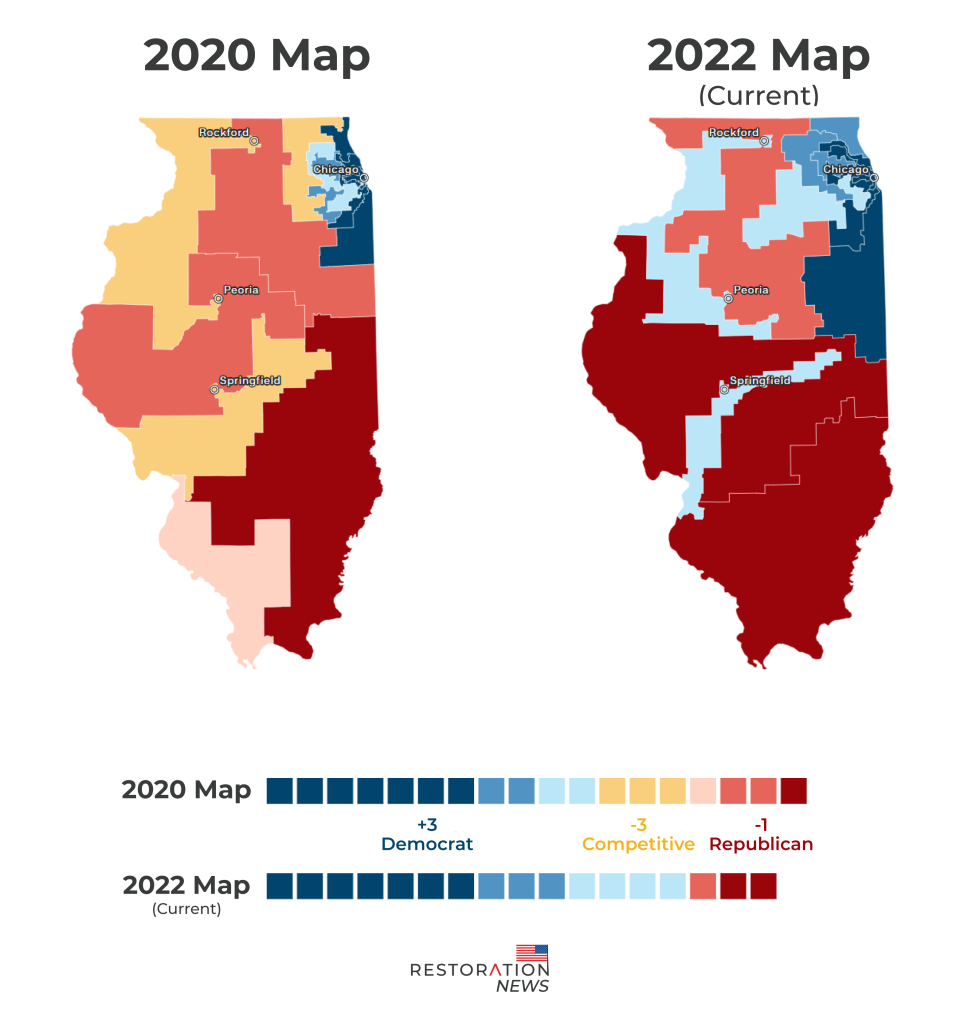
Democrat gerrymandering would be most effective in New York, Colorado, and California, which have sizeable Republican congressional delegations. Yet each state legislature has surrendered redistricting authority to an independent commission, something leftists swore a decade ago would yield fairer maps. In each state, voters voted for the commissions with substantial support from “progressive” advocacy organizations — some of which now shamelessly support plans to overturn those same commissions to “safeguard democracy,” or at least Democrat House seats.
Common Cause — which aims to abolish the Electoral College, lower the voting age to 16, and grant D.C. statehood — endorsed California Prop. 20 (2010), which gave control of congressional maps to the California Citizens Redistricting Commission, itself established by Prop. 11 in 2008 with support from Common Cause. Now the group won’t “pre-emptively oppose mid-decade redistricting in California” because it’s the only way to stop “President Trump and Republican leaders in states like Texas [from] doing all they can to prevent the people from having a say in our future.”
California Gov. Gavin Newsom, delirious with 2028 “Potomac Fever,” is plowing forward with a plan to gut four of the state’s nine Republican congressional districts and further deepen control of four more Democrat districts. “We anticipate that these maps will completely neuter and neutralize what is happening in Texas,” Newsom boasted in August.
The maps are part of Newsom’s Election Rigging Response Act, which would “temporarily” replace maps drawn by the California Citizens Redistricting Commission until the 2031 redistricting process. Kamala Harris, Nancy Pelosi, Hakeem Jeffries, Adam Schiff, and Eric Holder—who’s spent the past decade suing for “fair” maps — have endorsed the plan, as has the Democratic National Committee.
“We do not oppose — on a temporary basis — responsible, responsive actions to ensure that the foundations of our democracy are not permanently eroded,” said Holder, who once called California’s commission “a model for the country.”
The process is already sleazy. The California constitution prohibits the legislature from taking action on a bill until 30 days after it was introduced, so Democrats sidestepped that deadline with a practice called “gut and amend” — hijacking an existing bill that’s past the 30-day window, erase the contents, and replace them with Newsom’s redistricting language. Despite clearly breaking state law, the Democrat-run state supreme court rubberstamped the action in late August after Republicans objected.
Newsom’s plan could go into effect for the 2026 midterm elections and offset the Texas gains. There’s a hitch: It needs voter approval on the November 2025 ballot, yet the scheme may prove too Orwellian even for Californians — early polling shows voters oppose the scheme 64–36 percent. Even if Democrats climb this mountain, it’ll cost them billions of dollars just to save four congressional seats.

In Colorado, leftists are urging leaders to scrap the independent redistricting commission because “things are different now.” “I am opposed to the cancer of gerrymandering, but I respect those who don’t want to bring a knife to a gunfight,” says Kent Thiry, the mega-funder who bankrolled the 2018 ballot initiative that established Colorado’s commission. Democrats have filed an “emergency constitutional amendment” to allow the governor to “temporarily” replace the independent redistricting commission with a handpicked body to respond to any “national redistricting imbalances.” The problem: It has to be approved by voters on the 2026 ballot.
New York’s in a similar bind. In 2022, the state legislature tried to impose gerrymandered maps that would’ve reduced Republican congressional seats from 11 to just four — only to lose in court. Gov. Kathy Hochul (D) yielded control of redistricting to the independent commission, which generated GOP-friendlier maps, to the Left’s chagrin. Now Hochul is itching to disband the commission altogether — but even if she succeeded, state law precludes any new maps from taking effect until 2028. She’s floating a constitutional amendment to ignore the commission, but it too would need voter approval in 2026.
The True American Century is Dawning
Any one of these developments is worth celebrating. Taken together, they represent a sea change in American politics, gifting the GOP as many as 50 House seats with surprisingly little effort. Blue states are rapidly losing political relevancy. Texas and Florida are expected to add a million new residents each by 2030, growing 13 percent. The fastest-growing blue state, Colorado, may only grow by 10 percent.
Not only will Democrats be fighting on unfavorable turf, they’ll be spread thin at a time when the party is hemorrhaging cash and credibility. Fundraising has all but collapsed under Ken Martin’s tenure as DNC chairman, which was already fraught with power struggles with ousted vice chair David Hogg, who was supposed to win back the youth vote. Democratic voter registration has dropped 7 percent nationwide and is down in every single state that reports partisan registration figures—including many swing states—while Republican party registration is up 8 percent nationwide. In total, Democratic registration is down 2.1 million while Republican registration is up 2.4 million.
That doesn’t mean Democrats won’t get their act together before the next presidential election, but it does rob them of two important advantages: Money and organization.
It’s also clear that America needs to do far more than “fix our broken immigration system,” as Beltway politicians crow but don’t really mean. We need a fundamental, top-to-bottom review of who’s entering our country, where they live, and who gets to stay.
One of the pillars of the America First movement is making our economy work for us. But we can’t do that when politicians and corporations prefer to replace our children with H-1Bs and other imported labor. It’s not immoral to demand a system that prioritizes what’s good for Americans instead of what’s good for immigrants, otherwise there won’t be a country left for them to immigrate to.
There are good signs that things are changing.
For one thing, Hispanics aren’t creating a permanent Democrat majority, but a permanent Republican one. Despite the legacy media’s warnings, “racist MAGA Republicans” have flipped Hispanic-majority congressional seats across Florida and the Southwest over the past decade. Compared with 2020, Trump doubled his performance with Latino voters last year and swept all but four border counties in Texas. Nationally, Trump won 42% of Hispanics — better than George W. Bush’s performance in 2004 — and won Hispanic men outright.
“The radical Democrats assumed that flooding America with immigrants, both legal and illegal, would provide permanent constituencies of reliable Democrat voters,” Steve Cortes, a pollster and founder of the League of American Workers, explained. “But the globalist Democrat powerbrokers now learn a harsh lesson as Latinos across America rally to the America First movement in droves. Donald Trump’s 2024 performance was the best for any Republican ever among Hispanics, including a national victory among Hispanic men.”
Naturalized immigrants, long a crucial Democrat voting bloc, also swung 28 points from Joe Biden to Trump between 2020 and 2024. At the same time, the overall foreign-born population has dropped by 2.2 million in the seven months since Trump took office, driven by self-deportation.
One of the Right’s unsung victories is the spread of Citizen Only Voting Amendments to 14 states, including blue Colorado, to counter non-citizen voting. That effort is led by Paul Jacob, head of Americans for Citizen Voting, who’s expanding his focus to four more states in 2025 and 2026. “Democrats and the far Left continue to downplay noncitizen voting in places such as Michigan, where we know noncitizens voted in 2024, and in the 21 liberal cities where noncitizens are now voting, legally. Even those here illegally!” Jacob told me. “But Americans know better. Texas voters have it on this November’s ballot and three states—Arkansas, Kansas, and South Dakota—have already placed it on the November 2026 ballot.”
Even Democrats are changing their minds on mass immigration. In 1998, 58 percent of Democrats polled said “immigration is a threat” (two points more than Republicans!). That fell to an all-time low of 13 percent in 2020, but has since risen to 27 percent. That’s nowhere near high enough, but a sign that the nation is moving toward a closed-border consensus. Even left-wing strategists are suggesting the party pursue a restrictive immigration policy to win voters back.
Americans are crying out for an end to globalism and a return to unity. They are tired of the failed, soulless, technocratic international order, which has sacrificed our national greatness through endless wars and overseas commitments. We want to be a whole nation instead of a special economic zone for others to plunder. Only the America First movement has the power to bring the country into a new golden age and establish the true American Century.
The question for the sake of our children and grandchildren is this: Are we bold enough to seize that future?