The Permanent MAGA Majority (Pt. 1)

Editor's Note
Once a nation defined by citizenship and law, America now finds its borders pried open by the destructive Left. What was once a matter of sovereignty is treated as a tool to engineer a permanent Democrat majority.
As Hayden Ludwig shows in this investigative essay, the erosion of our borders was no accident but the result of a deliberate campaign. Now the tide is turning. Population shifts and political realignment point to a lasting GOP era — one that Democrats know they can only resist by cheating. Ludwig argues that our struggle will determine whether America will remain a nation of citizens or sink into a nation of clients, forever beholden to the Left.
It’s no mistake that only one political party in America is interested in stopping illegal immigration. Two decades ago, Democrat strategists bet the farm that mass Hispanic immigration, both legal and illegal, would eventually supplant the white majority and establish permanent Democrat control of Congress and the White House.
They’ve admitted as much: “Our path to the majority is through a new American electorate of Hispanics, African-Americans, young voters and women,” Democratic Congressional Campaign Committee chairman Steve Israel explained in 2013.
In the intervening years, of course, Democrats have sought a pathway to citizenship for the children of illegal aliens, expanded refugee programs, and even outright amnesty for those who enter our country without permission. Under Joe Biden, they simply opened the border to millions of people with tacit government approval from the immigration officials who are supposed to stop illegal crossings. All of this was under the theory that a rising Hispanic electorate would create an unbeatable Democrat majority in Washington.
That theory is dead. What leftists didn’t count on was Donald Trump and the nascent America First movement, leaving today’s Democratic Party approaching permanent minority status as the culture war comes to a close.
There are concrete reasons to suggest America is emerging from our generation-long culture war into a new consensus. The key evidence: the collapse of the Obama coalition, a sea change in how we view mass immigration, population flow to red states, long-reaching court decisions, and redistricting battles currently underway (with more on the horizon).
If you’re sick of the cold civil war that’s dominated politics for the past two decades, take heart, because conservatives are about to emerge triumphant. That doesn’t mean winning an election or two, or even the occasional “red wave.” It means regular, unbeatable congressional majorities of 20, 30, or even 50 seats for years to come.
This is what’s understood as “permanent majorities,” like the one New Deal Democrats enjoyed for 40 years following the Great Depression and believed they’d rebuilt under Barack Obama. Franklin Roosevelt’s coalition proved durable even after his death because it centered on workers and farmers — America’s core demographics, widespread and numerous — supplemented by urban black voters. As those voters turned right under Ronald Reagan, Democrats increasingly replaced them with Obama’s “rainbow coalition”: progressive whites, white-collar professionals, single women, gays, Millennials, minorities, immigrants, and most of all Hispanics.
As an investigative journalist specializing in Washington’s activist class, I spent years tracing the billions of dollars leftists poured into their crusade for a permanent Democrat electorate when that machine was at its zenith. You’re familiar with several of these: abolishing voter ID laws or opening up our southern border are two. But they also include less-familiar campaigns using “charities” to register tens of millions of new Democrat voters and manipulate the 2020 Census on blue states’ behalf.
Conservatives know the Democratic Party has spent decades monkeying with things like voting laws and judicial confirmations to rig them in their favor. We’re used to being disappointed with feckless Beltway Republicans, who always seem one step behind the Left. All that’s about to change despite the Left’s best efforts and the Right’s countless missteps. It’s Democrats, not Republicans, who are about to learn they’re playing a new game with old rules — and there’s next to nothing they can do about it. Let me explain why.
The Tide Turns in 2030
The party that controls the White House from 2029 to 2033, as well as the state legislatures during the 2031 redistricting process, will dominate the following decade. Even so, you don’t hear conservatives talking about the 2030 Census.
They should be.
The Census Bureau, which oversees that redistricting process, is officially nonpartisan. In reality, it’s controlled by the party that wins the election, and is certain to affect how accurately the bureau counts state populations. It’s crucial Republicans control the 2030 Census and ensure an accurate count. If they can manage to do so, they’re certain to keep a national majority for many, many years.
The Constitution mandates the federal government determine “the actual enumeration” of persons living in each state every decade. That data determines how all 435 seats in the U.S. House of Representatives — and consequently, Electoral College votes — are apportioned among the 50 states. For most of our nation’s history, the census was more or less apolitical, but massive population shifts from blue states in the northeast and California to red states in the South and West have almost exclusively benefited Republicans.
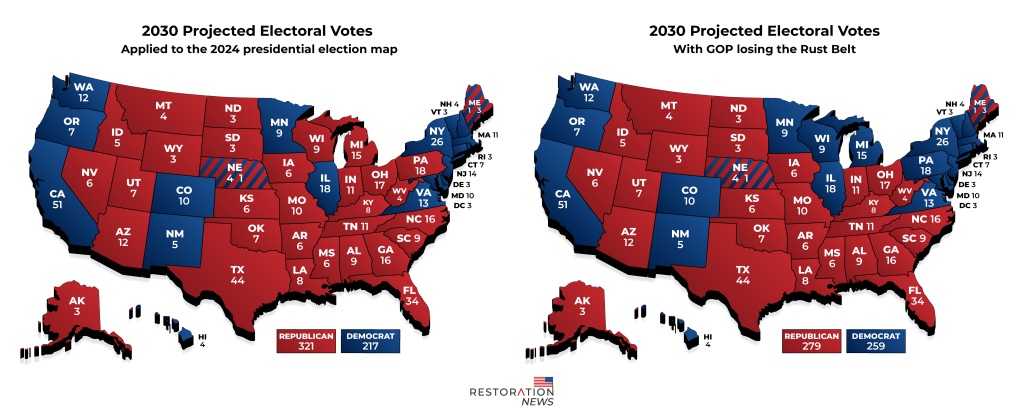
Between the 2010 and 2020 censuses, Red states netted seven additional House seats, mostly in Florida and Texas, while Blue states lost seven House seats. Swing states were more mixed: Michigan and Pennsylvania together lost four seats, while Arizona and Nevada each gained one.
That was bad, but 2030 is where things get disastrous for Democrats. According to current projections, Blue states should expect to lose between six and nine House seats. Pennsylvania and Wisconsin, both swing states, could lose one seat apiece, while purple Arizona could gain one more seat. Reliably red states could gain as many as ten additional seats in Texas, Florida, North Carolina, Utah, and Idaho.

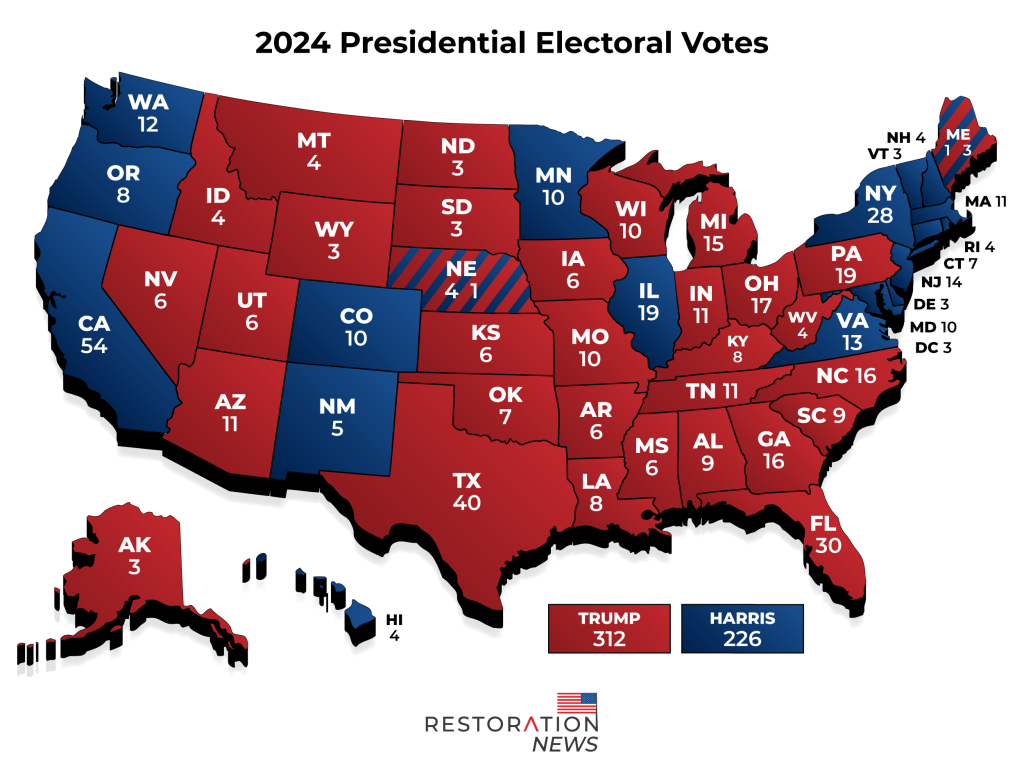
Another benefit for the GOP: States get an equal number of electoral votes as House seats. If the projected 2030 map were in place for the 2024 election, instead of a 312 to 226 electoral vote victory, Trump would’ve won 321 electoral votes to Kamala Harris’ 217. Amazingly, Trump could’ve lost the Rust Belt states of Pennsylvania, Michigan, and Wisconsin and still won the White House 279–259, simply due to massive population shifts south.
I cannot overstate how devastating this is for the Left. Decades of investment in the “blue wall” will be rendered meaningless in the 2032 presidential election, as will taking back Nevada, which is sprinting rightward in federal elections. But if Democrats gain control of the Census Bureau — while they won’t be able to totally stop the damage — they could mitigate it by undercounting red states and overcounting blue states.
In 2024, Kamala Harris had 25 plausible paths to victory; the 2032 map reduces that to just five. In part that’s because Democrats will likely be fighting in two more battleground states she narrowly won, New Hampshire and Minnesota, in addition to the seven battlegrounds from 2024. Data from the New York Times reveals that nine combinations of swing state victories that would have resulted in a Democrat win in 2024 now result in a GOP win in 2032.
For instance, had Harris won Wisconsin, Michigan, Pennsylvania, and Nevada in addition to Minnesota, New Hampshire, she would have won the presidency by seven percentage points. But by the 2032 math, a Democrat could win all six states and still lose to the Republican by two points.
The Left knows this, and that’s why they’ll try to cheat again.
Weaponizing the Census
In 2022, the Census Bureau announced it had undercounted 6 states, all but one of them Republican-run (Arkansas, Florida, Mississippi, Tennessee, Texas, and Illinois), and overcounted 8 states, all but two of them Democrat-run (Delaware, Hawaii, Massachusetts, Minnesota, New York, Rhode Island, Ohio, and Utah).
That error meant three Republican House seats that should’ve gone to Texas, Florida, and Tennessee remained Democrat seats in Colorado, Minnesota, and Rhode Island. That’s a big deal when the past three congresses have seen House majorities of just ten seats or smaller — and the current GOP majority is just seven seats strong, the narrowest in nearly a century.
That miscount wasn’t entirely by accident. While conservatives trusted the 2020 Census to Census Bureau officials, Democrats left nothing to chance. Leftist “charities” spent years ensuring people in big, blue cities — including homeless and non-citizens — weigh more heavily on the 2020 Census results than in Republican states.
This decade-long get-out-the-count (GOTC) project was coordinated by the Funders’ Committee for Civic Participation, a strategic hub of 90 progressive, tax-exempt foundations worth a cumulative $6 billion. The Funders’ Committee isn’t a grant-maker; it’s a convenor for other power players such as the AFL-CIO and Tides Foundation to synchronize spending on a single project.
Most of the committee’s objectives revolve around registering new Democratic voters in swing states using an “Integrated Voter Engagement” model that can “be mobilized to win effective public policies.” But it also ran a parallel Funders Census Initiative 2020 to improve census response rates and “mobilize constituencies” (i.e. Democrat-leaning demographics, including illegal aliens) in target states, funded exclusively by left-wing philanthropies.
Incredible as it sounds, this scheme only worked because the IRS allows 501(c)(3) charities to participate in “census advocacy,” engaging in “everything from advertising to door-to-door outreach by census workers and community organizations” alike. As the Funders’ Committee puts it, “It is vital that grantmakers get involved. The Census Bureau can’t do it alone.”
Beside boosting Democrat House seats in blue states, the ultimate goal is turning out Democrat voters. Data that’s acquired by registering people for the census can also be used for registering them to vote. To that end, the Funders’ Committee calls its model one of “the most effective ways to increase voter turnout” — despite clear IRS laws barring foundations from intervening in elections. The model was first used to powerful effect in Colorado: First by defeating a 2005 referendum on its Taxpayers Bill of Rights and later a 2008 initiative to eliminate affirmative action.
It’s little wonder that top Democrats have praised the Funders’ Committee. In 2015, then-Rep. Keith Ellison (MN) delivered its 2015 keynote address while Sen. Al Franken (MN) told members how important the census is in “determining how many seats in Congress are allocated.”
And they’re at work developing plans to shape the 2030 Census in Democrats’ favor, though details remain scarce. One advocacy group, Census Counts, already has a “roadmap” for using 2030 Census data for “targeted campaigns for rights and justice.”
What’s certain is the Funders’ Committee will battle the Trump administration’s new plan for an unprecedented mid-decade census that excludes illegal aliens. It’s already done so.
In March 2018, Commerce Secretary Wilbur Ross announced the coming census would ask respondents if they were U.S. citizens. (The Census Bureau does not distinguish between U.S. citizens and non-citizens, though it did include a citizenship question in its long-form questionnaire from 1960–2000.) In response, the Funders’ Committee held an “emergency briefing” with members and generated a letter signed by hundreds of leftist groups urging the department withdraw the citizenship question.
After months of deliberation in the courts, the Supreme Court ruled against the Trump administration — not that the citizenship question is unconstitutional, but that Trump officials hadn’t provided sufficient justification to add it to the census. With no recourse, the administration admitted defeat.
That’s a setback that can be overcome for the 2030 Census. We need to better prepared with a sounder strategy this time, because the next census fight will center on who we count.
The Effects of Counting Illegal Aliens in the Census
Non-citizens are barred from voting in federal races. But they still affect how many House seats each state receives following the census: something open borders advocates are keenly aware of.
“When I hear my colleagues talk about, you know, the doors of the inn being closed, no room in the inn, I’m saying, you know, I need more people in my district, just for redistricting purposes and those members could clearly fit here,” Democrat Rep. Yvette Clarke (NY) pointed out in 2021. As well she might: 35 percent of the people in her congressional district weren’t born in the United States, the 23rd-highest in Congress.
Imagine two congressional districts with equal populations of 760,000 residents, the national average for a district. District A contains 700,000 U.S. citizens and 60,000 non-citizens, including illegal aliens. District B, however, is composed of 400,000 U.S. citizens and 360,000 non-citizens. Both districts elect one representative with a single vote in Congress, but District A’s congressman represents 360,000 more voters than District B.
As a result, a vote in District B is effectively worth twice as much as a vote in District A, because there are far fewer District A voters dividing up the same congressional seat. This is the problem of representation inflation.
Non-citizens tend to cluster in urban areas and blue states, which rewards the Democrat Party by ballooning its representation in Congress. Democrats in these safe blue districts don’t pay a price for taking extreme policy positions so long as they encourage further mass immigration, both legal and illegal. This is the case even though many immigrants themselves hold conservative or traditional views, as is often true among Hispanics and Africans.
It’s little wonder, then, that the number of sanctuary jurisdictions has tripled since 2016 — to over 1,000 nationwide. Compared with the dozen or so that existed in the 1990s, that’s an 8,200% increase in a generation. The three states that allow non-citizens to vote in non-federal elections (California, Maryland, and Vermont, plus D.C.)have all passed sanctuary laws.
The result: artificially inflated congressional seats in Democrat strongholds and unequal representation for Republicans. Worse, it incentivizes a permanent slave-like underclass reliant on government benefits and beholden to Democrat politicians, who exploit them plantation-style for census representation and even illegal votes.
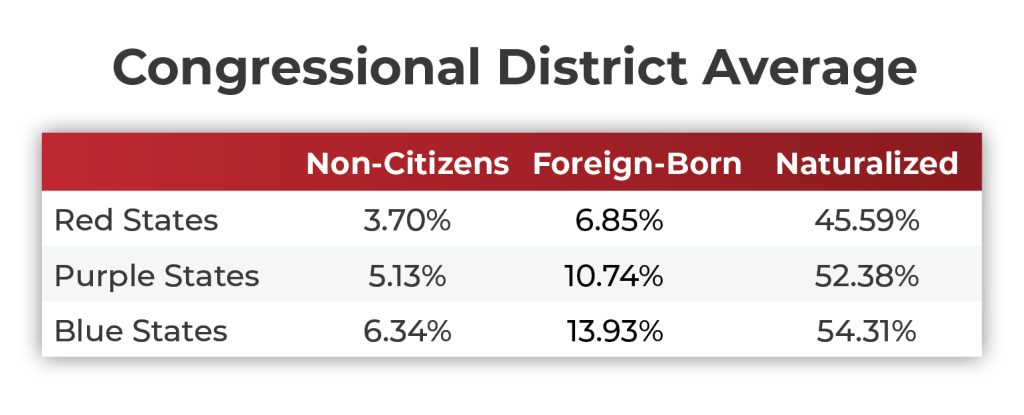
We see this incentive in the statistics. Red states average almost half the percentage of non-citizens and foreign-born residents as blue states. Of the top 20 states with the largest fraction of non-citizen residents, only six are red or purple.
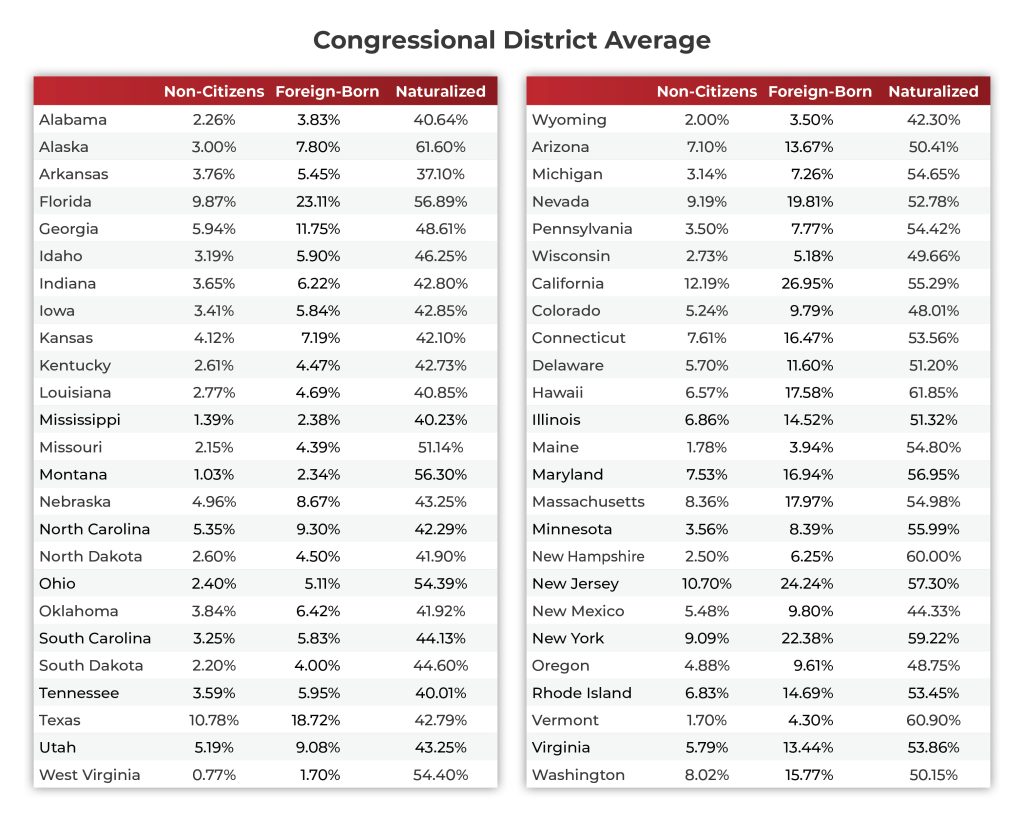
A shocking one-in-nine New Jerseyans isn’t a U.S. citizen, or about 1 million people in America’s most densely-populated state. In California, it’s one-in-eight — close to 5 million people in our most populated. In both states, roughly a quarter of all residents weren’t born in America; yet they only rank 6th and 11th for the percentage of naturalized citizens, respectively, meaning there are legions of people who live in our nation yet haven’t sworn allegiance to it.
The top 10 congressional districts by foreign-born population are concentrated in just five states. All are safe seats — seven held by Democrats — and none were competitive in the 2024 presidential election. Each is majority-minority, and six also rank among the districts with the largest percentages of non-citizens.

While we know there are 12.8 million lawful permanent residents, or green card-holders, in America, illegal alien estimates range from 50 million to a low of 11 million, the official statistic from the Department of Homeland Security. I prefer the Federation for American Immigration Reform’s estimate: 18.6 million people, more than 4 million of whom entered under the Biden administration.
The distribution of immigrants is a huge factor in reapportionment. Most illegal aliens live in a handful of states with significant foreign-born populations: California (27%), Texas (19%), Florida (23%), Illinois (15%), Georgia (12%), Arizona (14%), and New York (23%).
Theoretically, if all 18.6 million illegal aliens lived in a single state it might be eligible for as many as 24 House seats. In reality, 60 percent live in just 20 metropolitan areas across a handful of states, so for a truer count we need to use the Census Bureau’s official apportionment formula, which weights states by population and assigns them House seats one at a time (you can try this yourself at ApportionmentCalculator.com).
I estimate that removing all 18.6 million illegal aliens from the 2020 Census would have shifted 8 House seats to different states. That could net Republicans between two and four additional House seats, depending on how the battleground states Michigan and North Carolina draw their new districts.
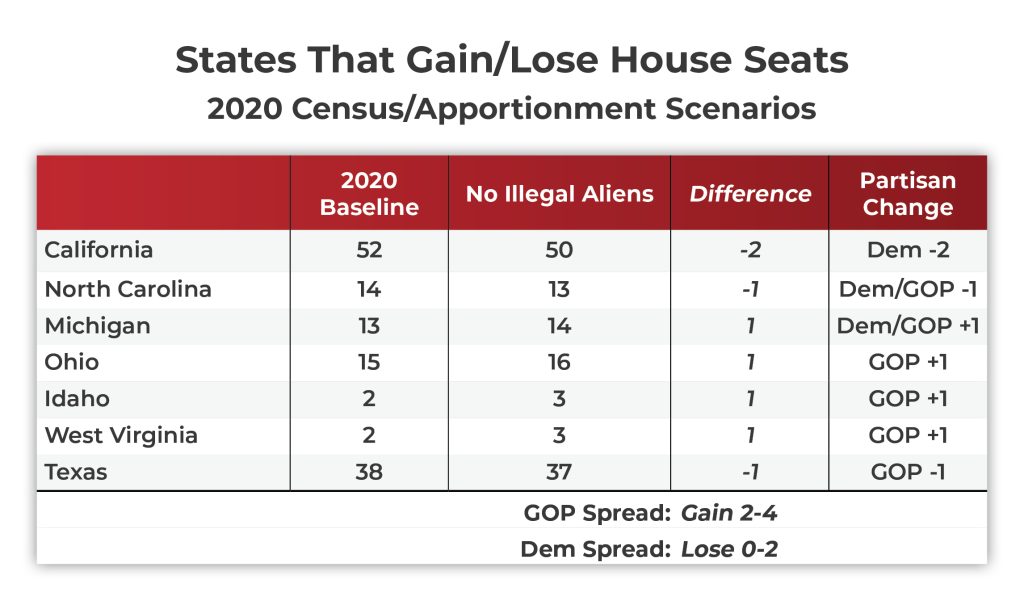
Incidentally, the apportionment math shows why Democrats want to grant statehood to the District of Columbia and Puerto Rico, netting them two more House seats (as well as four new Senate seats, of course).

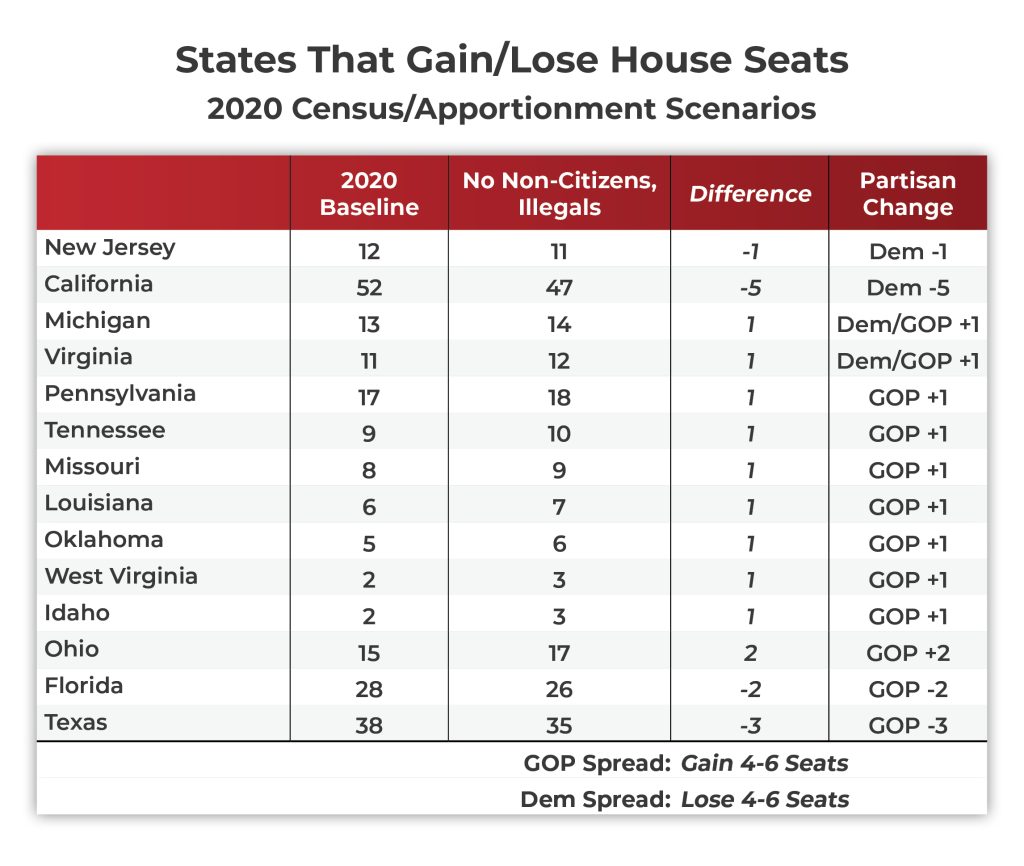
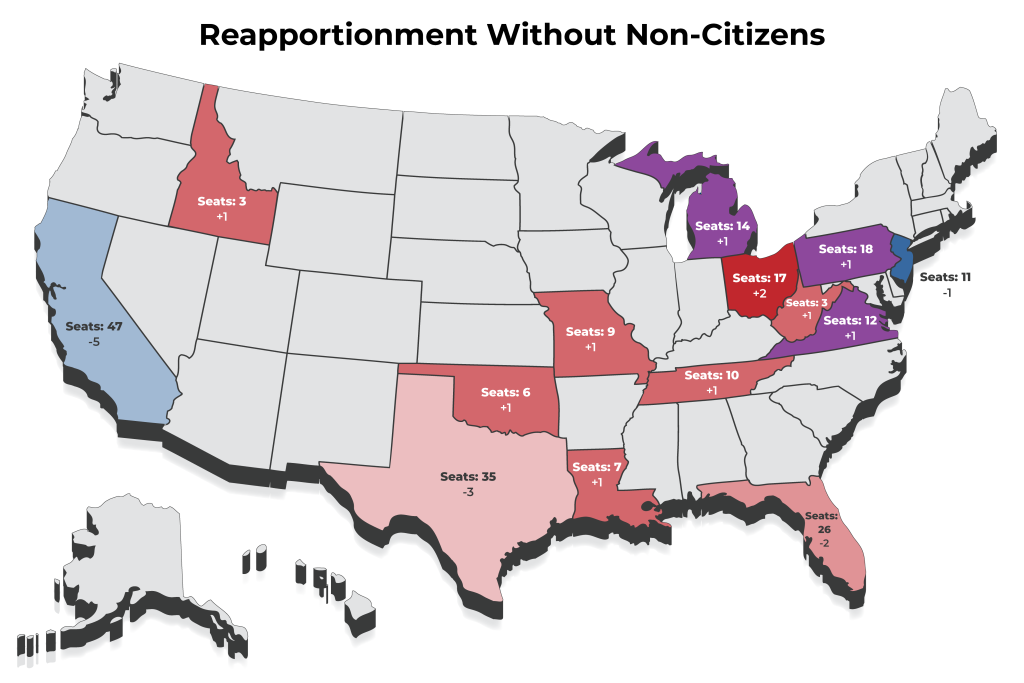
But what if we didn’t count any non-citizens in the last census? Excluding illegal aliens and legal non-citizens removes 41 million people from the apportionment formula, shifting 22 House seats. The result: Republicans could gain between three and six House seats from Democrat states. (As above, the final count depends on which party wins the newly-drawn seats in Michigan and Virginia, which could go either way.)
By this estimate, Trump would have gained another five electoral votes in the 2024 election for a total of 317– 221 if the 2020 Census had only counted U.S. citizens.
These aren’t scientific numbers by any means. They don’t account for how the districts are drawn, or whether marginal or safe districts would be axed in a state losing a House seat. But they illustrate the power of the census — and why the Left pours precious resources into controlling it.
The Case for a Citizen-Only Census
The figures also justify a citizen-only census, or at least one that only apportions House seats and electoral votes by U.S. citizens. This shouldn’t be contentious, yet it is.
The census exists to serve Americans, not Americans the census. It isn’t about collecting interesting demographic data; the census is meant to ensure the American people and state governments are properly represented in Congress — which is why it once counted three-fifths of all black slaves and indentured servants, but excluded “Indians not taxed.” In this age of transnationalism and dual passports, we have lost the older understanding of citizenship grounded in Scripture and Western wisdom.
True citizenship is more than where you live. Its value comes from being exclusive. Citizens are elites who enjoy privileges and prestige not held by foreigners passing through their land. If everyone is a citizen, the concept is meaningless.
The ancient Germanics believed in Freiheit, or the freedom to belong to a family instead of being a slave. “Free” meant being bound to kinsmen within a hierarchy, taking loyalty oaths in exchange for legal representation and protection — a far cry from our modern, “free to do as I please” libertarianism.
Similarly, Athenian citizens were indistinguishable from soldiers because the men who voted for wars were the same as those who fought them. Roman citizens once enjoyed immense legal protections and political advantages that peregrini (freemen) did not, hence the Apostle Paul’s fierce defense of his birthright as a Roman citizen in Acts 22. Then the emperors cheapened citizenship by giving it away to everyone, and lost in one generation what took centuries to establish. Rome collapsed when it grew dependent on foreign mercenaries to defend an empire they had not built and weren’t loyal to.
On the other hand, Biblical Israel was “holy” (hagios, “different”) because it was “set apart” from the other nations. Sojourners received hospitality, but had to become circumcised Jews at great personal cost to enjoy full communion within the Israelite nation. They were also subject to God’s laws while living in Israel’s borders. Even among the twelve tribes of Israel, God sanctified or set apart the Levites as priests “to stand and minister” in His name (Deut. 18:5). The Christian Church continued this commandment by distinguishing between members of Christ’s body and everyone else. It was only natural for European Christians, stewing in biblical thinking for millennia, to apply this salvific principle to secular affairs.
We inherited both traditions. Citizenship entails rights and responsibilities owed to my neighbors, who share a common destiny with my family not shared with people on the other side of the globe. As a Christian, I cannot love my neighbor if I don’t know him, making one-world governments tyrannical. As an American, I owe a lifelong allegiance to my state and the Constitution, making dual citizenship as dangerous an illusion as same-sex “marriage” or transgender transitions.
We used to know this. When the Thirteen Colonies declared independence from the British Empire, it wasn’t over taxes, but rather feudal rights and responsibilities. As subjects of the Crown, American colonists were under the authority of King George III, not the English Parliament. Receiving a tax bill from England’s Parliament in 1775 would have been like receiving a tax bill from London in 2025: unlawful and not owed. When the king responded to American petitions for redress by hiring Hessian mercenaries, he wasn’t suppressing rebellion — he was severing the feudal covenant that guaranteed his protection in exchange for the colonists’ fealty. Americans responded to the king’s declaration of war with a Declaration of Independence “absolv[ing] them from all Allegiance to the British Crown.”
This isn’t news; these are “facts . . . submitted to a candid world” 249 years ago. For the Founders, citizenship and borders were crucial to maintaining a free republic. George Washington left office deeply concerned about “the mischiefs of foreign intrigue” and “the impostures of pretended patriotism” by citizens sympathetic to foreign governments. We even fought a second war with King George III in 1812 to stop his government from pressing naturalized U.S. citizens into the Royal Navy as though they remained British subjects.
America is the product of this precious, ancient inheritance. Our unique genius was forging a continent-spanning republic settled exclusively by self-ruling citizens with one language, culture, and God. It became the wonder of the world because it lasted despite all odds.
However, history shows us we won’t last another century if we let the enemies of citizenship — globalism and multiculturalism — fester in our country. Being “America First” means asking tough questions about the current world order, about our trade and immigration policies, and which nation we’re truly loyal to. Before passing any law, every politician ought to be able to answer this guiding question: “Is this policy really good for the American people?” If the 2030 Census continues to put foreigners first, you have your answer.
Check back on Sept. 5th for part two of Hayden Ludwig’s “The Permanent MAGA Majority.”