The Death of the Ford Tradition
Editor's Note
Nick Short’s essay speaks to a central front in the cold civil war: control over the institutions that once made America strong. The companies that built the country’s industrial power are increasingly forced to operate as instruments of political priorities rather than engines of independent enterprise. What looks like an argument about electric vehicles is part of a larger struggle over whether American institutions will serve the country that built them — or the regime now trying to remake them.
One hundred and fourteen billion. That’s how much Ford, GM, Stellantis, Mercedes, VW, Rivian, and Lucid have lost on electric vehicles since 2023.
Ford alone has sold 410,000 EVs at a loss of $36.3 billion—nearly $89,000 per vehicle. Read that number again. Eighty-nine thousand dollars lost on every single car that rolled off the lot. These aren’t startups burning through venture capital on a moonshot. These are some of the companies that built the American automobile industry. And they’re hemorrhaging money on cars the government told them to build.
The EV push was never about market demand. It was about compliance. And compliance doesn’t require profitability—just obedience
I know this story from the other side. Not from a spreadsheet or a policy paper, but from a family photo album that sits in a binder held together with ring clips and typewritten captions. My great-grandfather, Harold G. Short, spent his entire adult life building Ford’s brand in small-town Ohio. His story is the story of what Ford used to mean—and what corporate America has lost.
Around 1916, H.G. Short started working on Model T engines at Newton Davis’ Ford garage in Marion, Ohio. Davis was the first Ford dealer in the area. In a photograph from that era, H.G. is on the left side of the workbench, bent over a Model T engine and transmission, his lifelong friend Dever “Dee” Imbody on the right. A third man, unidentified, stands in the center watching. H.G. was maybe twenty years old. He was learning a trade that would define his life, his family, and his town for the next half century.

H.G. Short (left) working on a Model T engine and transmission at Newton Davis’ Ford garage in Marion, Ohio, circa 1916–1917. His lifelong friend Dever “Dee” Imbody is on the right. The person in the center is unknown.
He married in June of 1917, two months after the United States entered World War I. The wedding photos show a Ford truck decorated for the occasion—“Just Married Harold G. Short” scrawled on the side, an American flag draped across the hood. His bride, my great-grandmother, climbed into a wooden crate on the back of the truck in her best dress and hat. The flag was there because the country had just gone to war. Patriotism and automobiles were already inseparable in the Short family. They met at her Uncle Charlie Hendricks’ place and neither one of them ever looked back.

H.G. Short’s wedding, June 1917. Decorated Ford truck with “Just Married Harold G. Short” banner and American flag across the hood, two months after the U.S. declared war.
H.G. started as a partner with Paul Moser at a Ford dealership in Kenton, Ohio, in 1923. After selling his interest there, he purchased the W.D. Coen Ford dealership in Bellefontaine in 1930—the seat of Logan County. Hugh Bowman, who had been a mechanic at the Kenton location, came along as Service Manager and later became a partner at the Kenton Ford sales operation. By the time H.G. was done, he owned and operated three dealerships: the flagship at 207–209 West Columbus Street in Bellefontaine, Short Ford Inc. in Marion, and Kenton Ford Sales.
H.G. Short & Co. sold Ford, Mercury, and Lincoln. Parts & Service on one side of the brick building. New & Used Cars and Trucks on the other. A neon Ford sign hung from a vertical pillar on the corner. It was the kind of Main Street business that held a town together. An average of 40 people worked at the Bellefontaine location alone.

The H.G. Short & Co. Ford-Mercury dealership storefront in Bellefontaine, Ohio. Neon Ford sign, brick building, “Parts & Service” and “New & Used Cars – Trucks” signage visible.
In 1933, a young man named Tom Cronley walked in and asked for a job. H.G. was skeptical about his age, but took a chance and hired him for $15 a week. Cronley made great strides and eventually became Sales Manager before leaving in the early 1950s to open his own successful dealership in Kalamazoo, Michigan. Other employees, such as Bill Barton and Fred Daring, went on to open their own dealerships in Bellefontaine. That’s what a healthy business ecosystem looked like. One man builds something, and it creates opportunities for dozens of others.

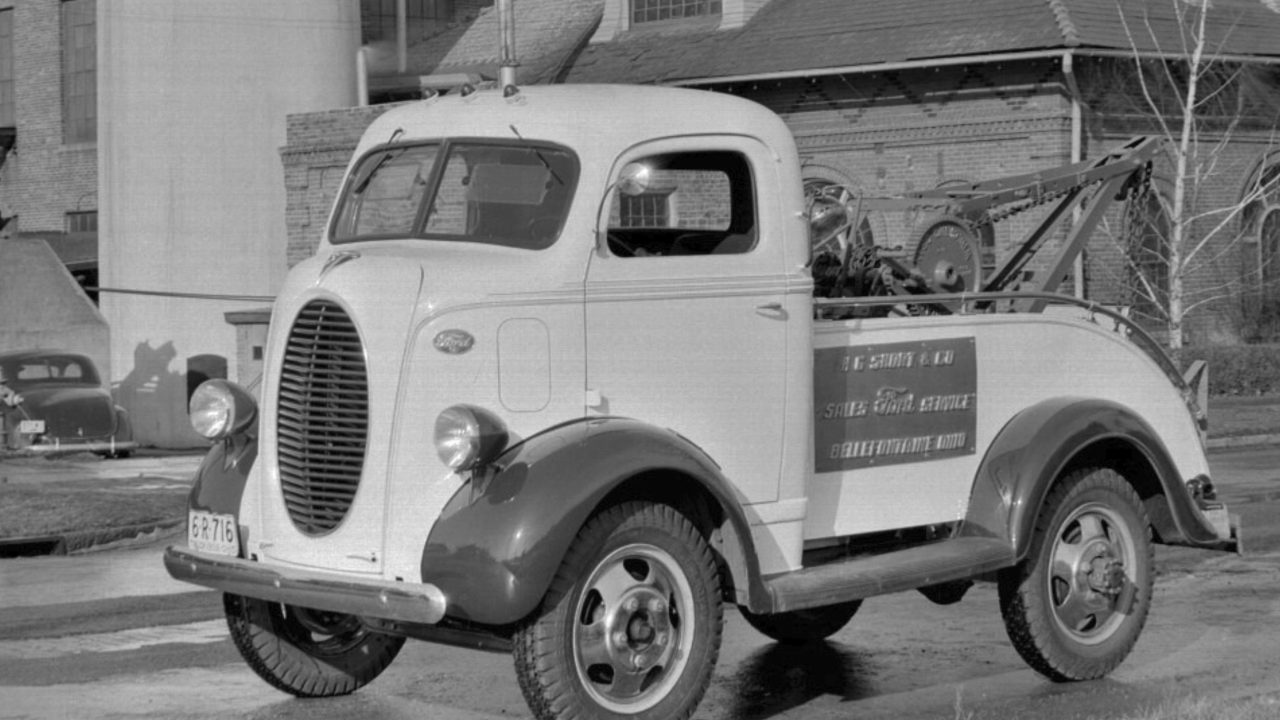
H.G. Short & Co. Ford service truck, Bellefontaine, Ohio. “Sales – Ford – Service” lettered on the door.
Ford treated its best dealers like partners, not vendors. Not data points on a regional sales dashboard. H.G. chartered a New York Central train car—the window sign reads “H.G. Short & Co. Ford Special Bellefontaine to Detroit”—and brought his top customers and friends to tour the massive River Rouge Ford industrial complex. The group included Tom Cronley, Clint Diener, Clark Tuttle, Rush Eichholtz and his father Bill, Tom Hubbard, Fred Hamilton, Charles Thomas, Pete Stuber, Shorty Reynolds, and Howard Traul. These weren’t anonymous corporate events. These were men from Bellefontaine and Kenton riding a train together to see where their cars were made. The caption from the family book notes, “It is assumed that a good time was had by all.”

H.G. Short’s promotional group posed in front of a New York Central train car. A Window sign, tough to see on the far left, reads “H.G. Short & Co. Ford Special Bellefontaine to Detroit.” A tour of the River Rouge Ford industrial complex was planned.
On another trip, the group flew on TWA, then known as “The Lindbergh Line.” This promotion involved flying to Detroit and driving new Ford automobiles back to Bellefontaine—cars H.G. had arranged to purchase in advance. In the photo, H.G. is first from the left. His brother Alfred is near the end of the line. Clark Tuttle, Pete Stuber, Herb Cross—the usual cast. These were relationships forged over decades, not quarterly sales meetings. Ford knew its dealers by name because its dealers knew their customers by name.

Ford promotional trip on TWA (“The Lindbergh Line”). H.G. Short is first from left. Dealers flew out and drove new Ford automobiles back to Bellefontaine. His brother Alfred and Pete Stuber are also pictured.
There’s a family story I love. H.G. was driving past the Ford administration building in West Dearborn when a car came down a driveway from the building and tried to enter street traffic ahead of his car. The driver held up his hand in a stop gesture. H.G. didn’t stop. He kept driving. He was fully convinced the driver was Charles Lindbergh himself, who at the time was doing gas mileage research work for Ford. A test of wills, my grandfather later wrote, between a small-town Ohio Ford dealer and the Lone Eagle. That’s the kind of man H.G. Short was. You didn’t cut him off—not even if you’d crossed the Atlantic solo.

H.G. Short’s dealer group posed in front of the Ford Motor Company administration building in Dearborn. The “FORD” lettering is visible on the building at top right. Stiff straw hats were in vogue.
A circa-1936 photo shows the family posed in front of the dealership with the Three Millionth Ford Truck. The banner on the side reads “Proved by the Past. Improved for the Future.” Standing next to H.G. is his bookkeeper Marguerite “Peg” Short (no relation, despite the name) and Sheriff Charles “Chuck” Bewley—a legendary Logan County lawman and close friend. My grandfather, the author of the family memoir, remembers being “all arms and legs at about age 12,” noting that “Chuck has a good grip.” The local sheriff and the local Ford dealer, side by side in a promotional photo for a truck milestone. That’s what community looked like.

The Short family posed with the “Three Millionth Ford Truck,” circa 1936. Truck reads “Proved by the Past – Improved for the Future.”
In 1940, H.G. participated in the Mercury Economy Test Run, an official gasoline mileage demonstration. The photo shows Bellefontaine Mayor Bob Cook signing a book for the Ford representatives who drove the test car into town, while H.G., Tom Cronley, Tom Hubbard of the Examiner, and the celebrated Police Chief John Lamborn all look on. The mayor, the police chief, the newspaper editor, and the Ford dealer—gathered on Main Street around an automobile. A Ford event wasn’t just marketing. It was a civic occasion. Chief Lamborn, the family book notes, “kept that cap so low over his eyes that some disbelievers thought he slept standing up.”

The 1940 Mercury Economy Test Run. Bellefontaine Mayor Bob Cook signs a book while H.G. Short, Tom Cronley, Tom Hubbard of the Examiner, and Police Chief John Lamborn look on. “Official Gasoline Mileage Test Car” banner on the vehicle.
When the war came, Ford answered. The company converted its Willow Run plant in Michigan to build B-24 Liberator bombers—at its peak, one rolling off the line every 63 minutes. The Dearborn Branch Ford Dealers were brought in to see the operation and posed for a group photo in front of one of the planes. The B-24 in the photograph was donated to the U.S. war effort by the dealers themselves. H.G. is in the picture, standing below the Ford “F” on the fuselage. A family cousin, Keith L. Babcock, flew combat missions over Europe in a B-24. Ford built the planes. Ford dealers’ families flew them. The company and the country were the same thing.

Dearborn Branch Ford Dealers posed in front of a B-24 Liberator at the Willow Run plant during WWII. The airplane, donated to the U.S. war effort, bears the “Dearborn Branch Ford Dealers” inscription. H.G. Short stands below the Ford “F.”
Back home, H.G. served on the County Rationing Board in charge of gasoline sales. He ran the local blood bank. He was voted Citizen of the Year by the American Legion Harold Kerr Post #173. He provided Ford police cruisers to the Bellefontaine City Police and the Sheriff’s Department. In 1956, the Bellefontaine Board of Education bought two 73-passenger buses from H.G. Short at a cost of $19,840. He furnished a Ford for the high school’s 1952 driver’s education class. A Ford dealer in that era wasn’t just a businessman. He was woven into the fabric of the town—schools, law enforcement, civic organizations, wartime service. The dealership and the community were inseparable.
After 30 years as a Ford dealer, H.G. personally drove to the Dearborn assembly plant to pick up his 5,000th car. Most deliveries by that point went by haulaway trucks and barges, but H.G. wanted to do it the way he’d done it the first time—in person, at the same plant where he’d picked up car number one three decades earlier. E.C. Miller, Ford’s Division manager, shook his hand while my great-grandmother looked on from the passenger seat.

H.G. Short receiving his 5,000th car in 30 years as a Ford dealer at the Dearborn assembly plant. E.C. Miller, Ford’s Division manager, congratulates him. My great-grandmother looks on from the driver’s seat.

Both the Bellefontaine and Marion dealerships won the Ford Four Letter Award—the highest honor given to a Ford dealer—for at least ten consecutive years. The plaque was signed by Henry Ford II himself.
Among H.G.’s closest friends was a man named Guy Van Dorn, whom my grandfather simply called “the great one.” Van Dorn had been captured from a freighter in the Atlantic during World War I by Von Luckner’s German raider and held as a prisoner of the German Navy. He later appeared on the television program “This Is Your Life.” He walked with a cane from a serious fall on the stairway at the Ingalls Hotel, right next door to the Bellefontaine garage—an injury that would have killed a lesser man. His son Warren was at Battelle Institute in Columbus when the dry copy process was perfected, and he tried to get his father to buy shares in Haloid—later Xerox—which Van Dorn declined, to his later regret. In the photo, Guy is talking, as he always was. A man with a million stories from his travels. These were the people who populated small-town America—characters with real histories, not consumers with demographic profiles.

Guy Van Dorn (left) holding court with friends. Van Dorn was a WWI prisoner of the German Navy and later appeared on “This Is Your Life.” He walked with a cane and had a million stories.
My grandfather told my father that he only saw H.G. cry once. It wasn’t over a deal gone bad. It was because he couldn’t pay all of his workers—and couldn’t imagine letting a single one of them go. His workers were his life.
Harold G. Short passed away in February 1969. In 1960, he had sold the dealership to Lloyd T. MacGillivray, his longtime General Manager, and turned his attention to real estate investments and continued civic work. He never needed a government mandate to sell cars. He never needed a subsidy to make his business model work. He built something real in small-town Ohio—three dealerships, hundreds of jobs over the decades, a business that supplied the town’s police cars and school buses and driver’s education vehicles. Local dealers, local jobs, civic duty, self-sufficiency. A company that figured out how to build cars people could actually afford and needed.
Now look at what’s left. Ford is losing $89,000 on every electric vehicle it sells. Not because the market demanded EVs, but because regulators did. The EV push was a compliance exercise dressed up as innovation. And the companies that once represented the backbone of American enterprise—the ones that built Model Ts and B-24 Liberators, the ones that gave small towns like Bellefontaine their economic identity and civic pride—are now bleeding out to satisfy bureaucrats who have never built anything, never employed anyone, and never shook a customer’s hand.
Ford meant something once. It was the backbone of American enterprise in small-town Ohio. It meant a man could start as a mechanic in 1916 and build an institution that lasted half a century. It meant the local dealer was the local leader—running the blood bank, equipping the police department, chartering trains for his neighbors to see where their trucks were made.
My great-grandfather would have called what Ford is doing today a disgrace. And he’d have been right.