John Wayne
Editor's Note
This story appears annually at tomklingenstein.com on May 26, in commemoration of 250 years—and counting—of American independence.
Twenty-two-year-old Marion Morrison, known to his friends as Duke, was carrying a table on his head across the soundstage of a John Ford movie. He was working as a prop man at the Fox Studio in L.A. early in 1930. Director Raoul Walsh was looking for a leading man for an epic western film he was developing about a great wagon train journeying across vast deserts and mountains to California. Walsh didn’t want a known star to play the lead. He was looking for someone who would “be a true replica of the pioneer type.” He didn’t want the audience to see a part being acted; he wanted them to see the real thing—“someone to get out there and act natural. . . be himself.” Then he happened upon the young Duke Morrison lugging a table across a soundstage.
“He was in his early 20s,” Walsh recalled, “[and] laughing. . . . [T]he expression on his face was so warm and wholesome that I stopped and watched. I noticed the fine physique of the boy, his careless strength, the grace of his movement.” “What I needed was a feeling of honesty, of sincerity, and [he] had it.” Within a few weeks, after a quick screen test, Duke would be signed up for the part of Breck Coleman, the fearless young scout in an ambitious film to be called The Big Trail; he would more than double his income, from $35 to $75 a week. He had to let his hair grow long and learn to throw a knife; and he would have a new name: John Wayne.
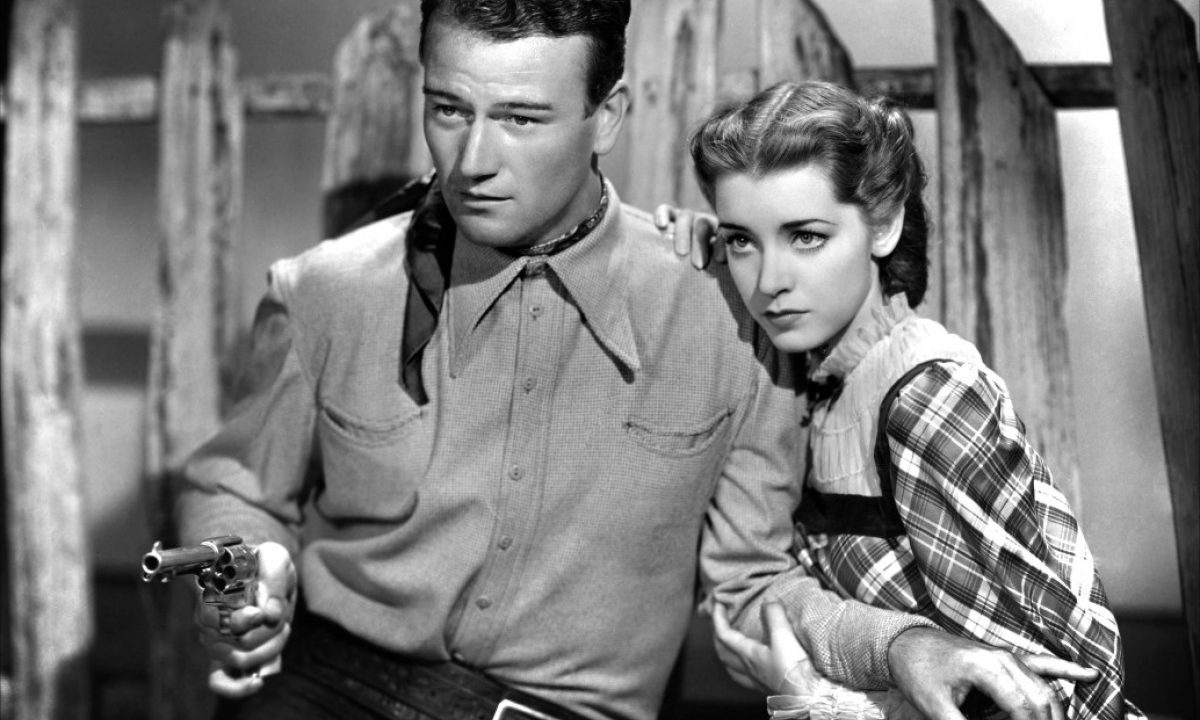
Already, as the young frontiersman in The Big Trail, the man the world would come to know as John Wayne is recognizable. He is more athletic and beautiful than we remember him from his later pictures, and he has a sweetness and shyness of youth that recedes over time, but he is “tough and in charge”; he has “a natural air of command.” The widescreen film is still visually stunning and interesting to watch, but it was an epic flop and left Wayne languishing in B movie purgatory for almost a decade before John Ford decided to make him a star as the Ringo Kid in the great western Stagecoach.
Ford was inspired by something similar to Raoul Walsh’s inspiration when he chose Duke Morrison for The Big Trail. “It isn’t enough for an actor to look the part and say his lines well,” said Ford. “Something else has to come across to audiences—something which no director can instill or create—the quality of being a real man.” Ford added that Wayne “was the only person I could think of at the time who could personify great strength and determination without talking much. That sounds easy, perhaps. But it’s not. Either you have it or you don’t.” John Wayne had it. As James Baldwin wrote, “One does not go to see [Katherine Hepburn or Bette Davis, Humphrey Bogart or John Wayne] act: one goes to watch them be.”
And Duke Morrison decided that John Wayne would be the kind of man he—and the audience—wanted to believe in. Whatever his flaws, and Wayne’s characters had many, he would present on screen a character that had something admirable in it. This character certainly added dimensions with his great films, like Red River and The Searchers. But its essence was discernable from the earliest days. He had courage and self-reliance, obstinacy and even ruthlessness; but also generosity of soul and spirit—the kind of “spirit that makes firemen rush into a burning building . . . [B]ecause it’s the right thing to do.” He had “humor, gusto, irascibility”; he was “bold, defiant, ambitious, heedless of consequences, occasionally mistaken, primarily alone,—larger than life.” As one of Wayne’s colleagues put it, “John Wayne was what every young boy wants to be like, and what every old man wishes he had been.”
Wayne was 32 when he made Stagecoach and 69 when he made his last film, The Shootist, in which he plays the dying gunfighter, John Bernard Books. His oft-quoted line from that film would have been right at home in The Big Trail: “I won’t be wronged, I won’t be insulted, I won’t be laid a hand on. I don’t do these things to other people, and I require the same from them.” For twenty-five years, from 1949 to 1974, he was among the top ten box-office stars every year but one. And he was more than a star for his time. Well into the 21st century, he was still listed as one of America’s five favorite movie stars; he became “indivisibly associated with America itself.”
On his 72nd birthday, May 26, 1979, as Wayne lay dying of cancer in UCLA Medical Center, the United States Congress, in a unanimous bipartisan vote, approved an order signed by President Jimmy Carter for striking a Congressional Gold Medal in his honor. Wayne would be the 85th recipient of the medal. The first recipient was George Washington. Winston Churchill was awarded the medal just a few years before John Wayne. As President Carter said, Wayne’s “ruggedness, the tough independence, the sense of personal conviction and courage—on and off the screen—reflected the best of our national character.” Wayne’s friend, actress Maureen O’Hara, testifying before Congress, said: “To the people of the world, John Wayne is not just an actor.” “John Wayne is the United States of America. He is what they believe America to be.”