Known But to God
Editor's Note
This story appears annually at tomklingenstein.com on Memorial Day, in commemoration of 250 years—and counting—of American independence.
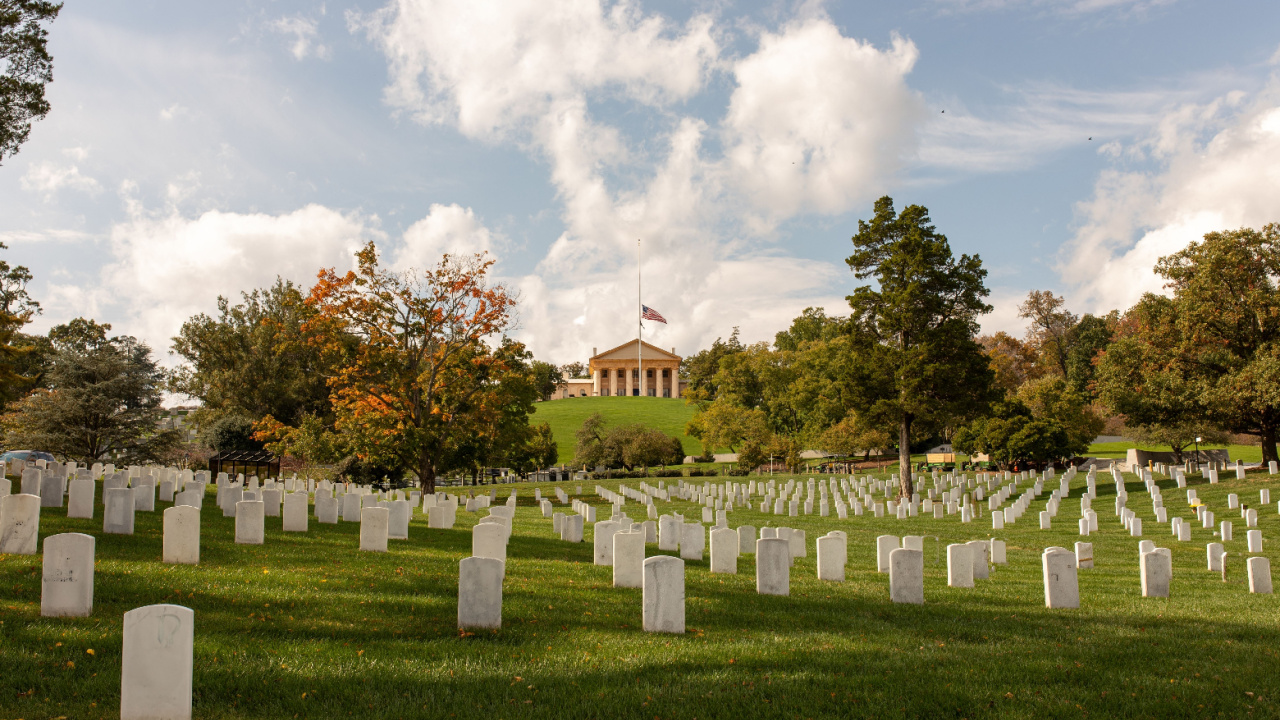
“HERE RESTS IN HONORED GLORY AN AMERICAN SOLDIER KNOWN BUT TO GOD.” These words all in capital letters are inscribed on the western façade of the Tomb of the Unknown Soldier in Arlington National Cemetery. More than 4 million visitors come to the cemetery every year from across America and around the world and, unless they have their own personal visit to make, the thing they most want to do is to climb the hill to the high ground of the Memorial Amphitheater and visit the Tomb.
The American Civil War brought forth Arlington National Cemetery, on land belonging once to George Washington’s family and later to Robert E. Lee’s. More Americans died in the Civil War than in all America’s other wars combined, and the first soldier buried at Arlington was Private William Christman, on May 13, 1864. The Great War, later tragically to become known as World War I, brought forth the Tomb of the Unknown Soldier. The American Expeditionary Force that fought in the Great War in 1917 and 1918 lost more than 116,000 troops. Identification tags were a relatively recent introduction of modern warfare, but still almost 2,000 American troops remained unidentified. One of those unidentified troops was selected for burial at Arlington, with solemn ceremony, three years to the day after the war ended, on what was then still called Armistice Day, November 11, 1921. The Tomb sarcophagus that we see today standing above the grave was completed and unveiled to the public in 1932. It is made of marble from the same quarry in Colorado that provided the marble for the Lincoln Memorial.
To the west of the Tomb, white marble slabs flush with the plaza mark crypts for an Unknown Soldier from World War II and another from the Korean War. Advances in technology over the years made being unknown more and more difficult. So for the Vietnam War there is a third marble slab, over an empty crypt, inscribed with the words, “Honoring and Keeping Faith with America’s Missing Servicemen, 1958-1975.” The Tomb of the Unknown Soldier touches visitors so deeply, in part, because it calls to our minds the reflection that the experience and sacrifice of all fallen soldiers must in some ways always be unknown to us, but they are not unknown to God.
At midnight, July 2, 1937, the Army began to maintain a constant guard over the Tomb. On April 6, 1948, these duties were assumed by the 3rd U.S. Infantry, known as “The Old Guard,” the oldest active-duty infantry unit in the Army. Since that day, twenty-four hours a day, every day of the year, in all weathers, The Old Guard has maintained a constant vigil. This sacred duty is carried out by the most specialized and famous platoon of The Old Guard, known as Sentinels of the Tomb of the Unknown Soldier.
The Changing of the Guard at the Tomb of the Unknown Soldier is what visitors to the Tomb rightly want to see. It happens every hour on the hour from October 1 through March 31, and every half hour from April 1 through September 30. It is the most visible manifestation of the sacred duty of honoring our fallen heroes. With exquisite precision and unbroken attention to detail, the Sentinels aim to make that ceremony perfect every time. They want to hold themselves to the ultimate standard by which men can be judged, because nothing less can begin to honor adequately the ultimate sacrifice they are there to honor.
For the millions of Americans, and foreigners, who visit The Tomb each year, especially the young, the Changing of the Guard offers profound moral and political instruction. What makes the ritual ceremony so powerful for visitors to see is that, in a vital sense, the visitors don’t matter. The Sentinels are most devoted to achieving perfection when they are not seen, when their precision, their attention to every detail, their concentration on the high purpose of honoring the fallen into eternity—is known but to God.