In response to: The Captive Mind Revisited
What Comes Next Is Worse
Editor's Note
Why are intellectuals — those whose thinking is supposed to be most refined — so susceptible to totalitarianism? Rod Dreher looks to the limitless danger of therapeutic morality — and the new developments of artificial intelligence — and warns that the new totalitarian era could be even more inhuman than the one witnessed last century.
Ryszard Legutko has been one of the most trenchant analysts of what he calls the “totalitarian temptation” inside liberal democratic thought. It is therefore a relief, indeed a pleasure, to read in his analysis of The Captive Mind the Sage of Krakow’s confident prediction that wokeness, the Huxleyan heir to Orwellian communism, is itself likely to pass into history, following its harsh predecessor — and for similar reasons: it is unlovely, aesthetically and intellectually sterile.
I hope Legutko is right; I am not sure that he is.
About the intellectual and aesthetic poverty of wokeness, Legutko is undoubtedly correct. And there are already clear signs that the Trump restoration not only heralds a counterrevolution, but is actually a political manifestation of a broader and deeper disgust with woke pieties. In the weeks following Trump’s re-election, a much-heralded artist told me that he was abroad on Election Day, but had he been at home, he would almost certainly have voted for Orange Beast. It was not that he shared Trump’s politics — indeed, he insisted that he remains a liberal — but rather that he was sick to death of the way militant wokeness had crushed artistic freedom and excellence in his field. Score one for Legutko.
Yet one can’t shake the feeling that it is too early to call this contest. There are several reasons for my pessimism.
For one, Communism failed to destroy the cultural memory of its subject peoples. It was still possible to hear classical music under the Bolshevik yoke. The Bolshoi Ballet remained a cultural jewel of Red Moscow, and if Communist students could not write novels and poetry of lasting value, at least they could still read Tolstoy, Dostoevsky, and Pushkin.
Today’s students in the West always could read the Greats … but nobody told them that it was important to do so. In 2015, after I delivered a lecture on the life-changing importance of Dante’s Divine Comedy, a confused college student rose to ask me why on earth anyone today should think the 14th century Tuscan had anything at all to say to the people of 21st century America. After all, she said, he was the product of a society that was racist and sexist.
As a journalist, not an academic, I thought she was joking. She wasn’t. A literature professor approached me after the question-and-answer session to assure me that the young woman’s question reflects the way nearly all students today think of the literature of the past.
Note well that it’s not so much that she found Dante to be ideologically problematic — that’s a given with the woke. It was that she genuinely could not see the point of paying attention to someone from an epoch less enlightened than our own. This educated young woman’s complaint was a culturally politicized version of the eternal questions lazy, incurious students pose to their teachers: Why do we have to read this stuff? What does it have to do with my life?
A middle-aged Italian friend, a Catholic conservative, once told me he valued the instruction he received from a particular Marxist professor at the University of Bologna. Though the older man was a dyed-in-the-wool leftist, he nevertheless revered classic books, music, and art, and taught his students to do the same. If that professor is still teaching, one can imagine his despair facing students who don’t care about the canon enough to argue with it.
This leads us to the second, and deeper, reason for my fear that proclaiming the imminent death of the Neo-New Faith might be premature. In his prophetic 1966 book The Triumph Of The Therapeutic, sociologist Philip Rieff made a statement that was bold in his era: that the psychological revolution that had just gotten underway in the West would prove to be more consequential than the Bolshevik Revolution of 1917.
Why? Because the cultural revolution of the late-liberal West, driven by the renunciation of all creeds and commands that bound the sovereign Self, was for that reason more radical than the Communist one, which belonged “to the classical tradition of moral demand systems.”
If wokeness is a form of totalitarian thought and practice — as Legutko correctly believes it is — then this form of totalitarianism is therapeutic. The great evil it seeks to vanquish is not capitalism, but anxiety. As Rieff saw more clearly than anyone else in the 1960s, the “therapeutic” was, and is, a mode of thought that is infinitely flexible. Its method is to free the anxious individual from any authoritative restrictions on his self-expression. “If it feels good, do it” was one of the popular slogans of the Sixties, and it’s hard to improve on that as a description of the therapeutic’s prime directive.
The protean nature of the therapeutic made it a natural fit for consumer capitalism. It also goes hand in glistening glove with the Sexual Revolution. For all its many faults, Marxism at least anchored itself in an authoritative set of doctrines binding human thought and action. Psychological Man (Rieff’s term for the therapeutic subject) exists for nothing higher than being pleased — that is, for pleasure, avoiding boredom, and seeking comfort.
If George Orwell, author of Nineteen Eighty-Four, was the great literary analyst of police-state Marxist totalitarianism, then Aldous Huxley, in his novel Brave New World, is the prophet of the therapeutic version. If you doubt me, consider what a college literature instructor told me twenty or so years ago: that he stopped teaching Brave New World because none of his students could understand what was so bad about Huxley’s dystopia. It sounded like a pretty cool place to them.
But what is wokeness but a puritanical moral demand system? How is it therapeutic? The answer is that it emerged as a frantic attempt of post-Christian people to impose, by force of will, their own rigid, Manichaean worldview onto society. The core moral stance of wokeness was to provide succor and justice to those it deemed as victims: women, migrants, and racial and sexual minorities. It succeeded for a while, and still does in many places (particularly in western Europe), largely because it affords bourgeois elites release from the guilt they feel over their own privilege, without having to pay a meaningful price. It is easy to favor mass migration from the Third World when the only time you have to encounter such “diversity” is in ethnic restaurants, or when you need someone to mow your lawn.
Legutko says Miłosz’s mission in The Captive Mind is to explore “why the East European cultural elites … gave their full-hearted support to the political system that was so unquestionably inhuman, mendacious, savage, and murderous.” The question today is why our own cultural elites — and many others — give their full-hearted support to a system that is so unquestionably anti-traditional, anti-historical, and fundamentally anti-human.
The answer is: because it is comfortable, and because it accords with what most people today, having been liberated from any unchosen values and norms, believe is true. A decade or so ago, the sociologist of religion Christian Smith reported bleakly that his broad study of the religious and moral beliefs of young American adults indicated that the overwhelming majority of them believe the meaning of life is nothing more than finding happiness and achieving material success.
In his recent book, Why Religion Went Obsolete, Smith, drawing on copious social science data, argues that Americans today are losing their capacity to believe in traditional religion, because they have been formed by a culture that, for a number of reasons, makes the claims of traditional religion hard to understand. Almost sixty years ago, Philip Rieff said the cultural revolution underway was “the systematic hunting down of all settled convictions.”
It succeeded. Now what? All of the social and cultural factors that Hannah Arendt identified in her 1951 classic The Origins Of Totalitarianism as indicative of a pre-totalitarian society — especially mass loneliness and atomization, the valorization of transgression, and indifference to truth — remain very much with us. We have had the sources of resistance to a more pleasant form of totalitarianism taken from us. Or rather, we were persuaded to surrender them.
Writes Legutko, of Communism: “It did not require any special mental effort to see the mind-boggling wickedness of the system, but it did require a special intellectual perversion to find beauty and hope in this wickedness.”
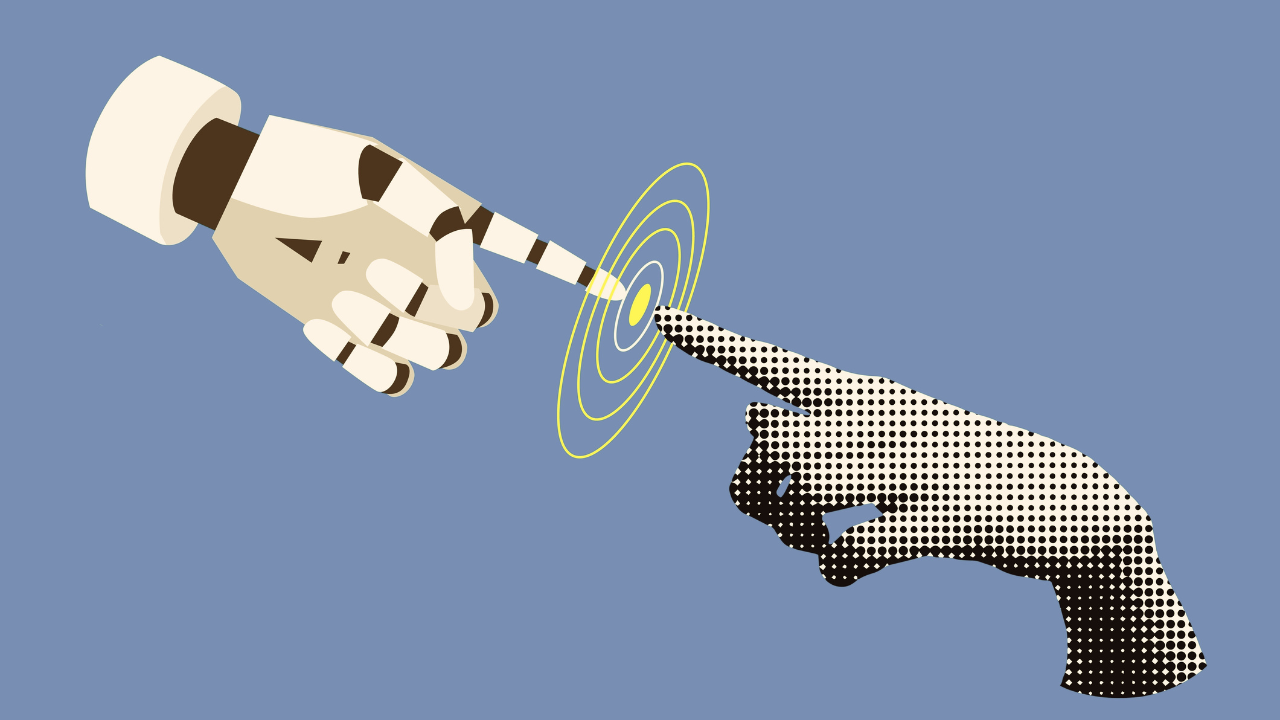
This is true of wokeness, which may not have been “mind-bogglingly wicked,” but was bad enough. But I don’t think it is true of the therapeutic utopia that AI’s promoters promise for humanity. They foresee a world of great material abundance, where machines do most labor, and the algorithms intelligently plan and manage human affairs. In Brave New World, the lone dissident — John the Savage — is characterized by his seemingly mad insistence on valuing pain and suffering as the cost of being fully human.
To resist the coming totalitarianism requires asking people to accept some degree of suffering as inescapable. Good luck with that. Once again, the stern moralist Philip Rieff saw sixty years ago deep into the selves we were becoming: “We believe we know something our predecessors did not: that we can live freely at last, enjoying all our sense — except the sense of the past — as unremembering, honest, and friendly barbarians all, in a technological Eden.”
I hope that conditions are different in Polish academia, but in the U.S. college professors and high school teachers report the collapse of the capacity to read and reason among their students — all driven by AI. Why read and think when the algorithm can give you the answer instantly? It’s so much easier. The Communists tried and failed to create a society of human robots. Our own techno-totalitarians are succeeding in merging man with the Machine by offering him a more friction-free existence. If the purpose of human life is to find happiness and material ease, and if one believes that one is bound by no moral order beyond the limits of one’s own desires, how will we resist?
In the recent film version of my book Live Not By Lies, Ludvik Bednar, an elderly Czech academic who was part of the Charter 77 resistance to Communism, says that it is more difficult today to get people to understand the creep of totalitarianism than it was under Soviet rule. Back then, it was easy to recognize evil. Now, vastly more subtle totalitarianism insinuating itself into the lives of contemporary people can scarcely be detected — especially by young people who grew up with no knowledge of how totalitarianism works.
Living as I do in the former Communist world, I often meet older people who talk about how precious books from the West were to them in the bad old days. Some risked their lives to smuggle samizdat copies around to their oppressed fellow citizens. They all knew that truth was real, and so was goodness, and beauty — and they knew that they were being systematically deprived of it.
Do we know? Do we care to know? As the late U.S. cultural critic Neil Postman put it, George Orwell feared the coming of a society in which people would not be allowed to read books. Aldous Huxley, by contrast, feared one in which nobody would want to. That’s where we are fast heading today. We are being lulled into Huxleyan servility, and those who raise the alarm are seen as cranks and reactionaries with as much cultural relevance as Huxley’s doomed prophet howling in the wilderness.
The Marxist totalitarianism Miłosz decried died because it was fundamentally inhuman. Its pale bourgeois successor, wokeness, is meeting a similar fate, for similar reasons. But what happens to a culture and a civilization that has erased in its people the memory of what it means to be human, and the desire to know it? What happens when we have abolished man?