The Reader Forum: ‘How Many Democrats Wish Trump Had Been Killed?’

Editor's Note
Each week, we ask our readers on X a question of profound importance to our nation and society. These exchanges have become an ongoing civic dialogue, shaped by readers willing to wrestle openly with difficult questions. Follow Tom’s account to take part in the discussion as it unfolds.
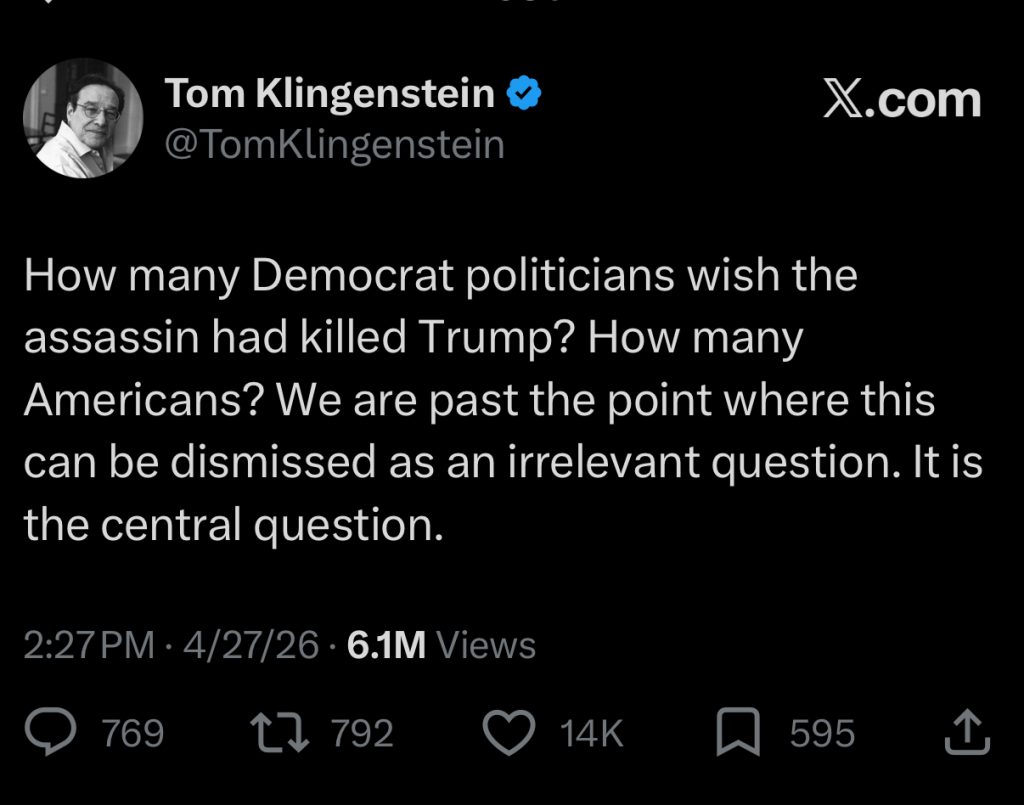
On X we asked: “How many Democrat politicians wish the assassin had killed Trump? How many Americans? We are past the point where this can be dismissed as an irrelevant question. It is the central question.”
The big picture:
Tom’s question landed on a readership that no longer treats it as theoretical. The dominant view was striking: Many — perhaps most — Democratic officeholders, and a meaningful share of the Democratic electorate, would have welcomed the outcome. Readers read the silence after Saturday night not as decorum but as evidence; the hatred not as rhetoric but as a settled disposition. The hostile half of the country has stopped pretending otherwise — and Tom’s readers see no reason the Right should keep pretending either.
The dominant sentiment:
Readers answered Tom’s question with a directness that itself reveals how the moral landscape has shifted: the only debate is the precise number, not whether the wish exists.
Scott Mechkowski: “All of them. They’re twisted”
Tom Cook: “Too many. Most Trump voters can probably share stories from their local community of their neighbors hinting or outright saying that Charlie Kirk’s death was his fault, was good, was necessary. The political hate came out in the open in 2016 and has only gotten worse. That is why we need to continue to talk with each other. @braverangels”
CharlestonSC: “Why so few (if any) Democrats condemning what happened on Saturday night? Because they’re disappointed.”
For these readers, the silence is the answer. The case isn’t built on what Democrats are saying — it’s built on what they aren’t.
By the numbers:
One reader anchored the conversation in polling already in the public record, offering a working estimate.
Margaret Auburn Grad 1776: “It’s pathetic and sad, but vital to know. I’ll assume until I learn more that it’s 25% because that is the number of democrats who believe political violence is warranted.”
Margaret’s figure gestures at the broad findings of recent political-violence surveys. If even a fraction of that share would have welcomed the bullet finding its mark, the implications run well beyond the partisan class.
Understanding the enemy:
A second strand of readers moved from the how many to the why, naming what the wish reveals about the Left’s project.
Fredster: “The far left don’t want to just kill Trump, they want to erase him and his movement completely from history and salt the earth so it never comes back. They were on a roll until he came along and wrecked their marxist utopian fever dreams”
Natalee: “They say Trump also needs to turn down the divisive rhetoric — but here’s the thing. Everyone knows Trump talks a lot of crap, he’s abrasive and crass sometimes. It’s who he is. No one (in their right mind) takes his jabs seriously because it’s well known. He’s just one man, and while he’s in a powerful position, he’s just one man. The other side has literally hundreds of people all saying the same message — people hear this same message at every turn. You cannot escape the hate and ‘8647’ rhetoric, it’s everywhere. Our society contains many, many unstable people who are just a step or two away from acting on all their hateful rhetoric. That’s clear since we’re on attempt #3 (that we know about) on the life of the American President. Until charges of Incitement or greater happen, they’re not going to stop. There’s a fine line between free speech and hate speech.”
Peter Barbera: “I’m curious as to just how far these idiots wishing for his assassination have really gamed this out. Do they think they can behave like an insurgency and not be treated like an insurgency? Newtons 3rd law.”
Three lenses, one diagnosis. Fredster names the motive: not defeat but erasure. Natalee names the asymmetry: hundreds of voices saturating the culture with hostile rhetoric versus one man whose abrasiveness no one in good faith mistakes for incitement. Peter Barbera names the trajectory: behave like an insurgency, get treated like one. The architects of this hatred have not seriously gamed out where the road ends.
A different reader pulled the same thread toward its political meaning.
Aaron: “Them wanting to kill him in my opinion means he is doing exactly why I voted for him”
For Aaron, the intensity of the enemy’s hatred is itself evidence of the man’s effectiveness — an inversion that turns the assassination wish into a confirmation of mandate.
Yes, but:
One reader pushed back not on Tom’s diagnosis but on the framing of the question itself.
plumber Tadd: “We’re past the questions. Everyone knows what everyone else believes. It’s all out in the open. There is no mystery. There is no common ground. It’s fundamentals that remain.”
For Tadd, the central question is no longer how many but what now. The numbers are already legible in the silence; what remains is the contest over fundamentals.
The other side:
A different kind of pushback rejected the Left-vs-Right framing entirely.
Independent Chick: “Why does personal feelings matter to anyone? You’re stuck in a right vs left 2016 narrative. Lol. How many on right? The uniparty? I’d bet all of them counting the days until he’s gone. They all hate him both sides and they all hate us. This is very obvious.”
From this vantage point, Trump’s enemies are not a party but a class — the governing apparatus itself, Republican and Democrat alike. A minority view among Tom’s readers, but a persistent one.
The bottom line:
Tom’s question was diagnostic, and his readers diagnosed in kind. The thrust of the responses is that the wish is no longer marginal, no longer deniable, and no longer confined to the fringe — it is, as Tom argued, the central question. Whether the precise number is all of them, too many, or one in four, the readers agree the wish is real and widely held, and that the appropriate response is neither shock nor lament but clear-eyed reckoning. The Left, several readers argued, has stopped hiding what it wants. The remaining work is not to keep asking — it is to act on what the silence after Saturday night already reveals.