It’s Time to Talk About the Trouble With Young Women
Editor's Note
While even young, credentialed women moved slightly rightward in the most recent election, they remain among the most reliably left-wing voting blocs, noticeably separated from other sex, race, age, and education cohorts. Scott Yenor explains this political divide as necessarily downstream of the core feminist narrative, and thus argues that rooting out that narrative will be a key step in resolving the cold civil war.
Nearly every demographic group moved noticeably rightward in America’s recent election. Even young women — among the most reliably left-leaning voting blocs — moved away from monolithic support for Democrats, but a significant gender gap of over 20 points persists between Gen Z women and men. Trump got only 33% of the 18-29 female vote in 2020; he got 40% in 2024. Compare this with 41% of the male vote in the same age group in 2020 and 49% in 2024.
Triumphalism at Trump’s victory should not obscure the long-term challenge posed by that gap.
This gender gap is often blamed on the rightward move of young men. Not so.
Women worldwide are moving left. “The trend in most countries has been one of women shifting left, while men stand still,” wrote John Burn-Murdoch in the Financial Times during fall 2024. Young men are drifting left by some measures as well, but with nowhere near the speed and enthusiasm of women.
Young women are the voter base of nearly every far-left political party and political cause in the modern world, from the German Left to Spain’s Socialist Workers Party. Estimates suggest that college-educated women made up nearly a third of the Democrat base in 2023, a proportion that has doubled in a generation. Young women, especially unmarried ones, broke hard for the Democrats in the United States in 2020 and 2022. They still broke for Harris in 2024, but not as hard. The Democrat Party is the single women’s party, as their media allies sometimes say.
Liberal young women support abortion on-demand, racial favoritism, gay rights, gun control, open borders, tax increases, and green energy. Brookings argues that young women are most interested in “sexual harassment, domestic violence, child abuse and neglect, and mental health problems.” A recent poll found that white women with college degrees have opinions far different from white men with or without college degrees and white women without college degrees. Unlike the other groups which are either sour or neutral on DEI and the war in Ukraine, for instance, white women with college degrees favor DEI by 31% and the war by 53%. They hate DOGE and Trump. They are hardly concerned about bread-and-butter issues like economic growth, unemployment or budget deficits. Young, credentialed women increasingly aspire to suppress speech in workplaces and through laws.
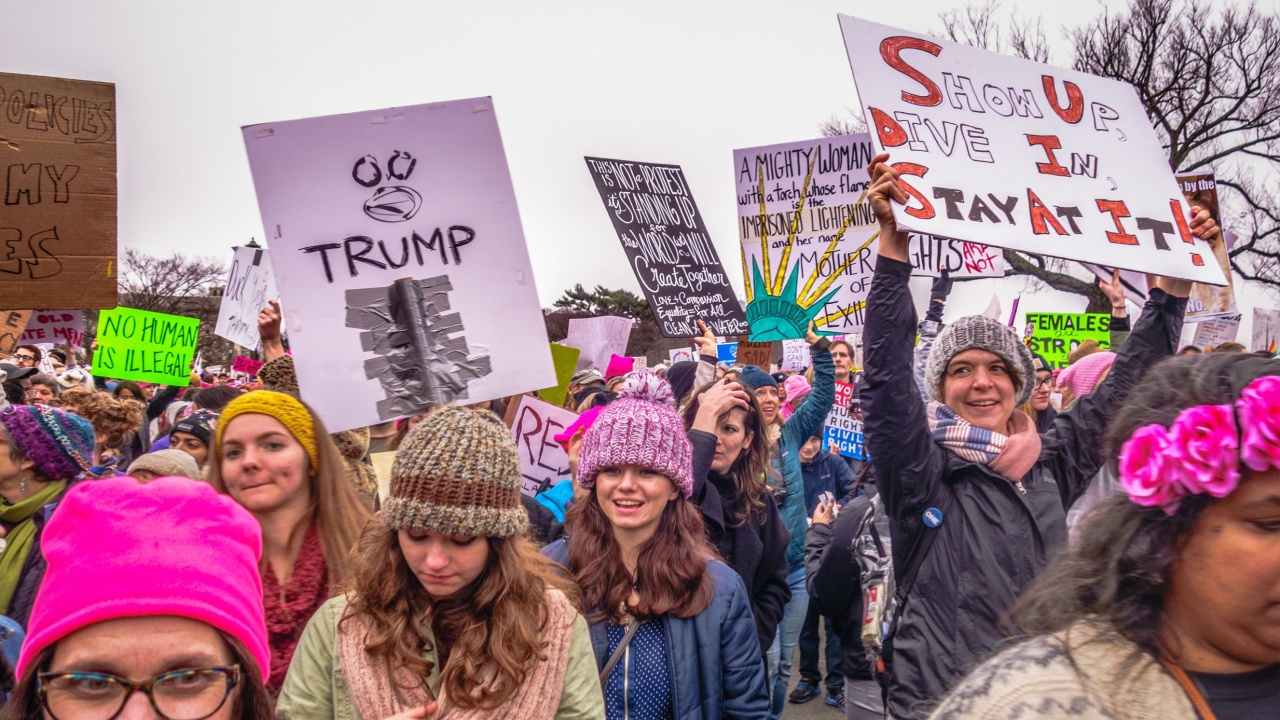
Issue-by-issue political beliefs do not fully capture their opinions. The “future is female” is a partisan vibe. Young, liberal, college-educated women are activists, disproportionately involved in public protests and proudly quarrelsome in public confrontations — especially in the pro-Hamas protests of 2024. They see themselves as disruptors. Well behaved women rarely make history!
The American and global left increasingly turn to young women for political viability as their historic working-class base drifts to the right.
Democrats tailor their agenda and appeals to the concerns of young, college-educated women (and famously have little to say to young men). They aggravate and exaggerate female grievances to keep these new core voters in the fold. See the Democrat theme of the “War on Women” from 2010 and beyond. This grievance culture is roundly rewarded on campus, where progressive administrators teach young women that making radical complaints and grievances will win them awards and concessions.
As a result, young liberal women feel ever more aggrieved and discriminated against. More women favored affirmative action plans for women in 2021 (72%) than in 2001 (57%), just as their general satisfaction with how society treated women dropped from 61% in 2001 to 44% in 2021. These young liberal women amazingly believe themselves to be more discriminated against than previous generations, though Gen Z men around the world and in America support gender equality at least as much as previous generations. An astonishing 87% of young, female Democratic voters think women face some or a lot of discrimination today.
Liberal women, especially highly credentialed liberal women, perceive themselves as victims of sexual harassment and sex discrimination more than their conservative counterparts. This preoccupation with grievance politics — I call it compulsory feminism — coincides with skyrocketing rates of female depression and creates a contemporary battle of the sexes.
Gen Z females are “struggling with their mental health.” A third of 18-year-old females experience depression, compared with only a tenth of boys. Why? Politics, says America’s CDC and Britain’s National Health Service. In The Impact of Culture on Human Experience, Boston University sociologist Liah Greenfeld shows that liberal countries, and liberal regions within countries, tend to have higher rates of mental disorder.
Study after study shows that rates of depression among liberal females and males alike are markedly higher than those for conservatives since at least 2010. Depression among white young female liberals is the highest of any demographic in America. Social psychologist Jonathan Haidt shows that 56% of white liberal women aged 18-29 have been diagnosed with a mental health condition. The same trends in liberal women’s mental health are present in Canada and Australia. All indications are that young liberal women turn to medications to deal with depression more than other groups as well, as NPR reports.
Most revealing are recent numbers on happiness and life satisfaction. Young liberal women are dramatically less satisfied with their lives than young conservative women. According to Brad Wilcox and Grant Bailey, 37% of young conservative women are “completely satisfied” with their lives, while only 12% of young liberal women are. Unhappiness is linked to weak social connection. Young liberal women are lonelier than other demographic groups, according to Wilcox and Bailey. They are less likely to marry, less likely to join churches or community groups. Much more likely to join a protest.
The anti-discrimination frame adopted by young liberal women fosters this depression and unhappiness. Every drawback or snub provides evidence of persistent discrimination or patriarchy. As liberal author Matthew Yglesias writes, “mentally processing ambiguous events with a negative spin is just what depression is.”
Female anxiety and suspicion stoked, young women became less interested in marriage and motherhood than previous generations. Remarkably, today men under 35 are more likely to want children (57%) than women (45%). More young men think marriage is important for a fulfilling life (about a third) than young women (22%). A strong majority of women (55%) think that single women are happier than married women, but men are very skeptical of this perception. As indeed they should be, since married women thrive more and consistently report greater happiness than single women.
Single liberal women tend to believe many things that simply aren’t so. Living according to the feminist narrative is not, in the main, living well.
Everyone should be concerned about these trends. Nearly every public institution encourages girls to embrace anti-discrimination politics and to view marital or personal connections with suspicion. Credentialed white women swallow more propaganda than any other group in American society.
Many are unwilling to trace the declines in liberal female happiness and mental health to the feminist political narrative. Centrist psychologists like Haidt and Jean Twenge, for instance, avoid conservative-coded explanations for increased female depression. By their account, it’s social media that causes young women’s struggles.
Yet the content and context of social media matter. Consider a counterfactual. If social media were filled with celebrations of women’s condition in the West, would it be contributing so powerfully to female depression? The rise of social media coincided almost exactly with the Great Awokening, and it is filled with feminist and queer theory of the most aggressive, aggrieved varieties.
Most major Gen Z influencers think sexism or misogyny lurk in every corner of life. Young women are drilled constantly in the “great untruth,” as Haidt calls it, that society is divided into victims and oppressors.
This attitude has political consequences. No phenomenon in human life can be explained without reference to the good, the advantageous, and the just. Social media instills just such a framework of values, demonizing imaginary male oppressors, advertising a future of never-ending sexual reparations, and encouraging young women that their only route to personal agency is politics — a future that can never materialize and would be an unceasing misery for all involved if it did. The festering discontent this produces expresses itself in angst and desperation, which motivate irrational and counterproductive political agendas, leading in turn to more desperation and more angst.
Another theme in respectable discussions of this “gender divide” is to create room for male empathy or counseling men to find a way to relieve the anxiety that women feel, to show that they will not threaten women. “These hands won’t harm!” was a t-shirt I once saw on campus — one that reflects this strategy perfectly.
This only indulges the false narrative of oppression and victimization that brings so much unhappiness. A solution that treats these lies as immovable objects in the social universe will be no solution at all.
The paranoid, unnatural, feminist worldview is the gender problem that exists today. Young liberal women, striving for independence from family, God, and country, wind up politically radical and sad. Their war against perceived oppression separates them not only from the other half of the country but from the natural sources of happiness. This is unsustainable on both the personal and the political level. For their sake and the country’s, we must trace the disorder to its root, and strike it there. We must be anti-feminist.
Reconnecting liberal women to the American traditions of faith and family — and to the American divide between private and public life — is a necessary step toward healing our nation’s deep, persistent wounds.