Days to Remember
Editor's Note
This story appears annually at tomklingenstein.com on December 15, in commemoration of 250 years—and counting—of American independence.
On December 15, 1791, a historic revolutionary and constitutional deliberation was (for the moment) concluded. On that date what came to be called the Bill of Rights became part of the Constitution. Certainly this was a day to remember.
The deliberation had begun in the Constitutional Convention in Philadelphia in the summer of 1787; it continued through the ratifying conventions of thirteen states, from the fall of 1787 to the summer of 1788; it then moved to the first Congress of the United States of America under a new Constitution convening in New York in spring 1789; then back to the legislatures of all the states under that Constitution in fall 1789. At every stage of this historic deliberation, representatives of the self-governing people debated with one another in elected bodies with varying legal authority, a free press carried on a robust public debate in pamphlets and newspapers, and the revolutionary and constitutional statesmanship of James Madison was active on all fronts seeking to bring wisdom to consent.
Among many days worthy of remembrance, one that is often forgotten is June 8, 1789, when as a member of the House of Representatives, in the first Congress under the newly ratified Constitution, Madison addressed the House in a historic speech. The government had been operating for only a few months. Only eleven of the thirteen states that had fought in the Revolutionary War were represented in it. Rhode Island and North Carolina still had not ratified the Constitution. Several states had submitted proposed amendments to the Constitution with their vote for ratification (over 200 of them), trusting that the first Congress would consider these proposed amendments.
Madison thought it was the duty of Congress to take these proposed amendments into consideration, and he selected from them several that he himself could support, that did not in his view blemish in any way the “beauty” of the Constitution, that would be likely to be approved, and that would demonstrate to some doubting citizens that they should support the new government. He observed that many respectable Americans were worried about the power of the newly created government and wished to have some explicit affirmations of their rights as was a familiar practice in many of the state constitutions.
He reasoned that “We ought not to disregard [the inclinations of these citizens] but, on principles of amity and moderation, conform to their wishes, and expressly declare the great rights of mankind secured under this constitution.” Such a declaration would be perfectly in harmony with the principles of the Revolution that animated the Constitution. He added that an even stronger motive for declaring these rights explicitly was that this should help persuade Rhode Island and North Carolina to join the other eleven states in what he called the “confederacy.”
According to the still very new Constitution, Madison’s proposed amendments would have to be approved by two thirds of both houses of Congress and then by three fourths of the legislatures of the states who were part of the United States. With some important exceptions historians like to point out, the House of Representatives largely accepted Madison’s proposals and shaped them into seventeen amendments, which the required two thirds of the House approved.
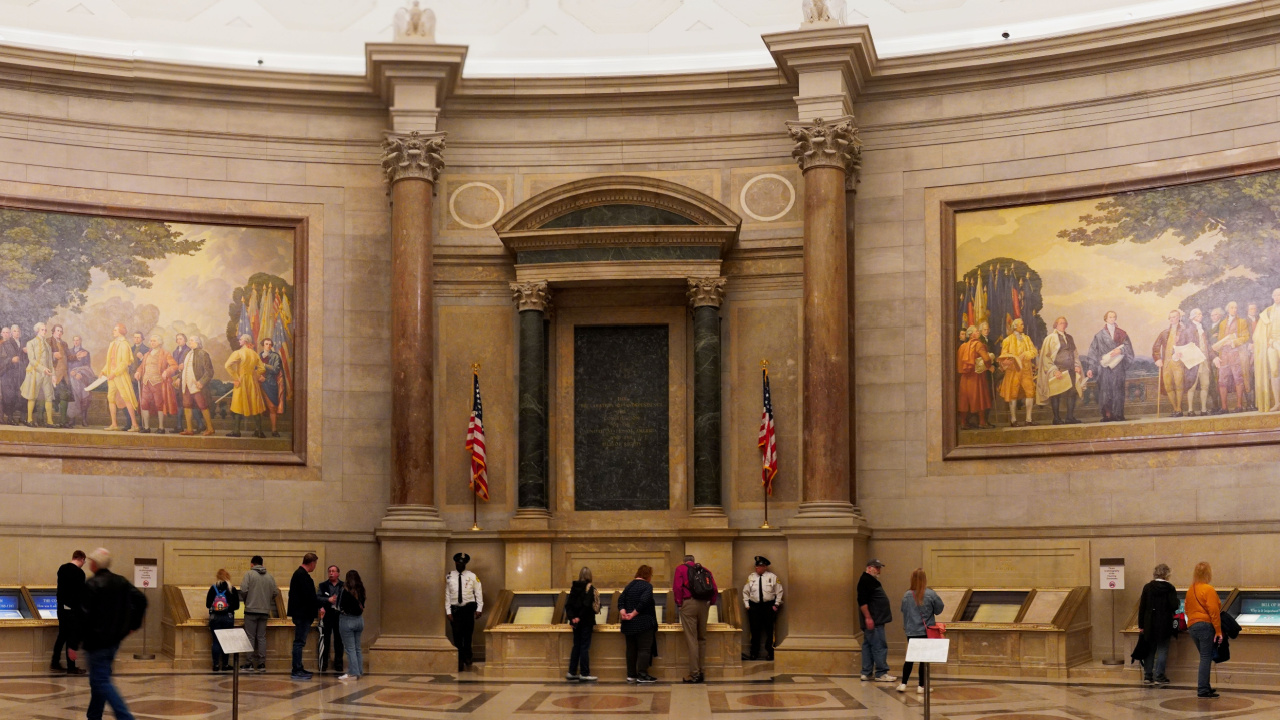
One of the exceptions, which had great consequences, was that the House decided to add these amendments on at the end of the Constitution, rather than engraft them into the document as Madison had proposed. Two thirds of the Senate approved twelve of the seventeen amendments approved by the House, and by a joint resolution of Congress these twelve amendments were submitted to the states for ratification on September 25, 1789. It is the original of this joint resolution that now joins the Declaration of Independence and the Constitution in the Rotunda of the Charters of Freedom at the National Archives Museum in Washington, D.C.
When these amendments were submitted to the states, Rhode Island and North Carolina had still not yet ratified the Constitution, so only nine states were needed to ratify the amendments. Two years later, by December 15, 1791, Rhode Island and North Carolina had joined the “confederacy” and Vermont had become the fourteenth state, so when Virginia became the eleventh state to ratify ten of the twelve proposed amendments, they became part of the Constitution.
Not until the early twentieth century did it become common to refer to these ten amendments as the Bill of Rights. But on November 27, 1941, in response to a joint resolution of Congress, President Franklin D. Roosevelt issued a proclamation designating the forthcoming December 15 “Bill of Rights Day.” This would be the 150th anniversary of the day to be commemorated, December 15, 1791, and the president called upon officials of the Government “to display the flag of the United States on all Government buildings on that day, and invite the people of the United States to observe the day with appropriate ceremonies and prayer.”
Between Roosevelt’s late November proclamation and his radio address on December 15, the Japanese attacked Pearl Harbor and Nazi Germany and Fascist Italy declared war on the United States. His radio address was titled: “Address of the President Broadcast in Connection with the Celebration of the 150th Anniversary of the Adoption of the Bill of Rights.” But it was now a wartime address, rallying all “liberty-loving” people in the world against Germany, Italy, and Japan, whose purpose, he said, was “precisely the destruction of the rights” declared in that document.
In the first sentence of his “Bill of Rights Day” radio address, Roosevelt said: “No date in the long history of freedom means more to liberty-loving men in all liberty-loving countries than the fifteenth day of December 1791.” James Madison would appreciate the sentiment but recommend July 4, 1776, and September 17, 1787. He would be too modest to include June 8, 1789.