American Moses
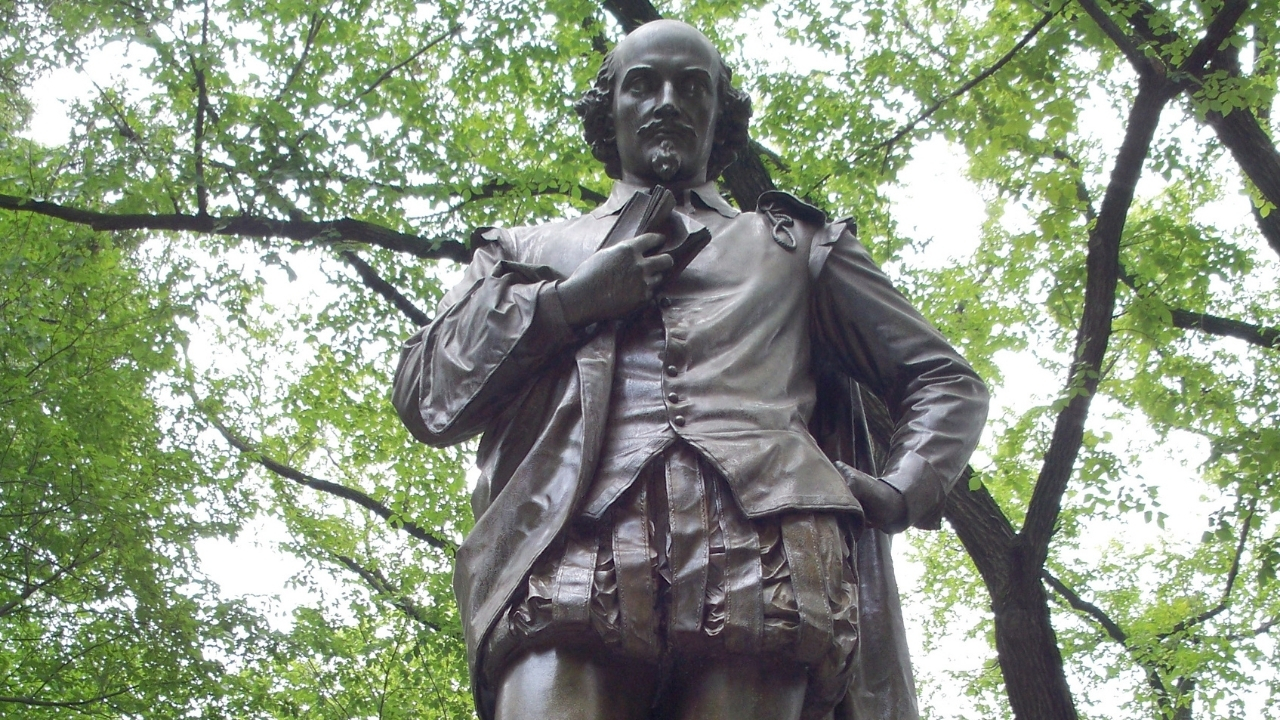
Editor's Note
This story appears annually at tomklingenstein.com on April 23, in commemoration of 250 years—and counting—of American independence.
William Shakespeare was baptized on April 26, 1564. Because of this, his birthdate has traditionally been celebrated on April 23, the feast day of St. George, patron saint of England, which also happens to be the date on which he died, in 1616, fifty-two years later. Americans have good reason to celebrate Shakespeare’s birthday.
James Fenimore Cooper called Shakespeare “the great author of America.” Since Americans assumed their separate and equal station among the powers of the earth, no other poet has so deeply penetrated and thoroughly inhabited the souls of the American people, awakening and informing our sense and sensibilities about practically every interesting dimension of the human things—love, tyranny, revenge, virtue, vice, justice, free will, providence, chance, fate, friendship, loyalty, betrayal, passions and reason, men and women, nature and convention, ruling and being ruled, high ambition and low scheming, war and peace, and the variety of human characters and regimes. Drawing upon the likes of Aristotle, Cicero, Locke, and Sidney, Thomas Jefferson aimed, with the Declaration of Independence, to give noble expression to the American Mind. In Shakespeare we discover the furthest reaches of the American Soul.
Jefferson thought that “a lively and lasting sense of filial duty is more effectually impressed on the mind of a son or daughter by reading King Lear, than by all the dry volumes of ethics, and divinity that were ever written.” John Adams’s diary entry on a Sunday in February 1772 expressed a typical view, regarding Shakespeare as “that great master of every affection of the heart and every sentiment of the mind.” Because Shakespeare was a great master of every human affection and sentiment, he was as Adams later wrote in his Discourses on Davila, a “great teacher of morality and politics.” The judgments Jefferson and Adams made about Shakespeare were rooted in the same understanding of nature and human nature that inspired and shaped the American Revolution. In the divine or natural order of which human beings are a part, it is possible to discern some things that are more beautiful or noble than others, some things more or less just, more or less admirable. In light of such distinctions ascertainable by reason and common sense, one might recognize Richard III as a tyrant and George Washington as a great souled man. The capacity of men to make such distinctions justified a decent respect for the opinions of mankind and was the necessary condition of self-government.
What Alexis de Tocqueville observed in his American travels in the 1830s merely confirms what is known from other sources. Tocqueville found Shakespeare in “the recesses of the forests of the New World. There is hardly a pioneer’s hut that does not contain a few odd volumes of Shakespeare.” A half century after Tocqueville’s visit, a less well-known German traveler named Karl Knortz found Shakespeare so influential in this country that he wrote a book about it: Shakespeare in America. “There is, assuredly, no country on the face of this earth,” he wrote, “in which Shakespeare and the Bible are held in such high esteem as in America… If you were to enter an isolated log cabin in the Far West… you [would] certainly find the Bible and in most cases also some cheape edition of the works of the poet Shakespeare.”
Ralph Waldo Emerson was reputed to know “almost all of Shakespeare by heart” by the time he arrived at Harvard College. In his maturity, he regarded Shakespeare as “the first poet of the world,” one who “fulfilled the famous prophecy of Socrates, that the poet most excellent in tragedy would be most excellent in comedy.” Emerson considered Shakespeare “the most robust and potent thinker that ever was.” In this, he was registering a judgment similar to that rendered generations earlier by the English poet John Dryden, who wrote of Shakespeare that he was “the man who of all modern and perhaps ancient poets had the largest and most comprehensive soul.”
Such a judgment was common among educated, and even uneducated, Americans from the earliest days of American independence.
Animated by such an understanding, generations of Americans have picked up Shakespeare eagerly to read him, or gone eagerly to his plays, in hopes of finding, not just sublime and earthy enjoyment—which they find in abundance—but great treasures from which they might benefit: insights into the things that matter most to them in the world. Abraham Lincoln preferred to read his Shakespeare aloud, thinking he understood more when the thought came to him through both eyes and ears. There are many stories of him reading Shakespeare in New Salem, Illinois, as a young man and later as a lawyer carrying a volume of Shakespeare with him as he rode circuit. He memorized many substantial passages and was fond of reciting them. By the time he was president, his secretary, John Hay, would report of him that he “read Shakespeare more than all other writers together.”
W.E.B. Du Bois took his ability to be of one mind withShakespeare and the other great thinkers of the world as a sign of his humanity.
I sit with Shakespeare and he winces not. Across the color line I move arm in arm with Balzac and Dumas, where smiling men and welcoming women glide in gilded halls. From out the caves of evening that swing between the strong-limbed earth and the tracery of the stars, I summon Aristotle and Aurelius and what soul I will, and they come all graciously with no scorn nor condescension. So, wed with Truth, I dwell above the Veil.
In his “Defence of Poetry,” Percy Bysshe Shelley wrote that “Poets are the unacknowledged legislators of the world.” To the extent that this is true, Shakespeare is the American Moses.